Mastering Scalable Cross Functional Delivery Workflows Across Distributed Cloud Native Systems
Introduction
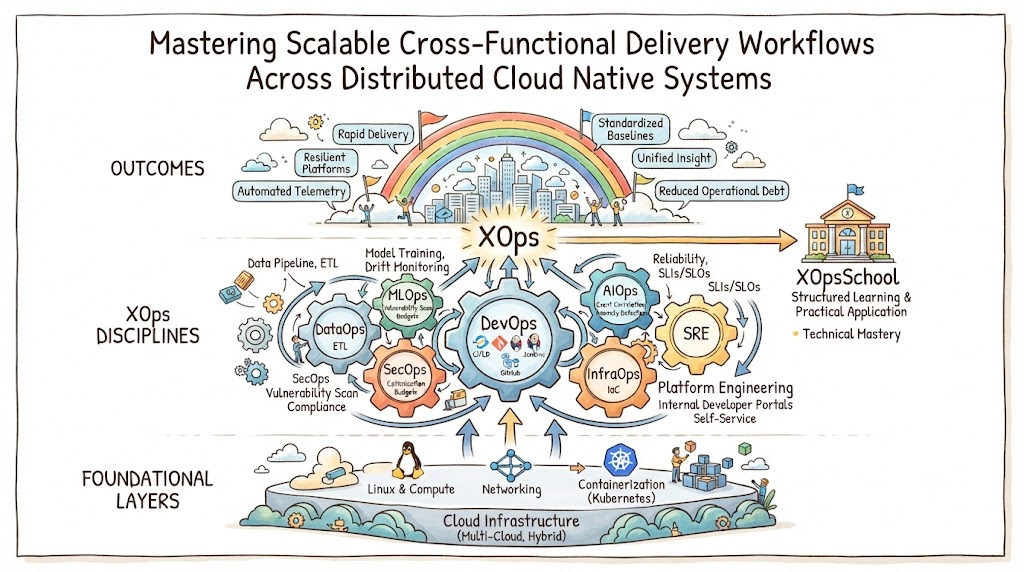
Rapidly shifting cloud environments compel engineering organizations to unite previously separate delivery, analytics, and operational functions into a coordinated operational model. When application developers, data professionals, security analysts, and system administrators operate in isolated environments, critical delivery pipelines stall, unexpected bugs slip into production, and distributed systems suffer extended outages. Modern computing architectures demand that teams coordinate microservices delivery, continuous data streaming, machine learning rollouts, and infrastructure governance under a single comprehensive strategy. Adopting XOps as an umbrella approach bridges these fragmented engineering groups, creating an adaptable and synchronized workflow across every layer of the enterprise technology stack. Independent educational hubs like XOpsSchool guide engineers through this practical transition by breaking down these advanced methodologies into hands-on implementation skills.
What Is XOps?
Enterprise software delivery utilizes XOps as a unified operational philosophy where the letter “X” denotes any specialized technical domain across the digital ecosystem, encompassing software engineering, data management, artificial intelligence, security, and financial stewardship. Instead of maintaining distinct boundaries between these disciplines, this operational paradigm binds declarative automation, continuous deployment pipelines, integrated observability feeds, and site reliability engineering principles into an interconnected operational fabric. Picture an enterprise payment engine processing real-time credit card charges: developers release updated microservices through continuous delivery pipelines, data teams curate transaction databases via DataOps workflows, machine learning practitioners roll out fraud detection engines with MLOps pipelines, security analysts scan configurations, cloud accountants monitor asset costs, reliability engineers enforce latency budgets, and algorithmic systems group platform alerts to stop critical outages before customers notice. Aligning these diverse operational paths behind common data definitions and continuous testing protocols eliminates friction, speeds up feature releases, and ensures complete visibility across distributed corporate environments.
What Does XOps Include?
Modern software infrastructure brings together several specialized engineering paths to maintain an automated, reliable, and horizontally scalable production environment.
| XOps Discipline | Primary Focus | Typical Responsibilities |
| DevOps | Continuous delivery and deployment automation | Orchestrates automated build pipelines, supervises container runtimes, and writes infrastructure configurations. |
| DataOps | Continuous data processing and validation | Manages streaming data pipelines, audits dataset schemas, and traces data transformations. |
| MLOps | Machine learning lifecycle orchestration | Builds automated model pipelines, evaluates production model drift, and manages inference clusters. |
| AIOps | Algorithmic telemetry and alert clustering | Ingests real-time metric streams, identifies statistical deviations, and automates event triage. |
| SecOps | Security automation and policy enforcement | Executes static code analysis, audits third-party packages, and secures cloud identity permissions. |
| FinOps | Cloud cost transparency and resource governance | Analyzes compute resource spending, establishes asset tags, and eliminates idle cloud assets. |
| SRE | Service uptime and reliability governance | Configures service level objectives, writes auto-remediation routines, and conducts system post-mortems. |
| InfraOps | Base hardware and network provisioning | Configures physical compute clusters, establishes software-defined routing, and maintains hardware health. |
| Platform Engineering | Internal developer platform design | Creates internal developer platforms, establishes default deployment templates, and exposes self-service infrastructure APIs. |
Every individual operational practice directly strengthens the broader delivery ecosystem, transforming isolated technical tasks into a synchronized, enterprise-wide production engine.
What Is XOpsSchool?
Operating as an educational platform, XOpsSchool bridges technical knowledge deficits across cloud-native computing and enterprise operations through systematic, hands-on learning resources. The platform provides curriculum pathways that explore declarative infrastructure, container orchestration, machine learning delivery systems, and automated platform governance. Students and practicing engineers explore difficult architectural concepts through hands-on exercises, architectural diagrams, and implementation labs that utilize Kubernetes, Terraform, Argo CD, and Prometheus. Emphasizing production realities over theoretical concepts, this learning platform demonstrates how varied operational specializations integrate within live enterprise systems, helping technical professionals master modern cross-functional engineering skills.
Why Is XOps Important?
Modern distributed environments generate immense operational friction because microservices, serverless workloads, and multi-cloud footprints produce massive amounts of raw telemetry every minute. When tech departments separate their analytical pipelines, container platforms, and artificial intelligence models into isolated silos, critical integration points fail, leading to undetected defects and extended customer-facing downtime. Modern machine learning features alongside strict regional data compliance policies require automated security gates, rigorous data checks, and proactive cloud spend governance. Unifying these dependencies within an integrated operational strategy tears down communication barriers, builds shared technical responsibility, removes duplicated tooling, and ensures that cross-functional teams construct dependable, resilient, and cost-efficient production services.
Why Choose XOps Training?
Pursuing comprehensive multi-disciplinary education grants engineers broad technical competence that transcends the limits of narrow specialization. Cloud operators, software engineers, and system administrators build an integrated perspective on how application code talks to distributed databases, continuous security validators, and artificial intelligence prediction endpoints. This multifaceted understanding sharpens collaborative root-cause analysis during major production disruptions, refines high-level system designs, and speeds up enterprise-wide automation initiatives. Acquiring cross-disciplinary capabilities provides engineers with enduring, career-proof capabilities that readily handle shifting industry standards without relying on temporary software trends or marketing promises.
How Does XOps Training Work in Practice?
An effective operational syllabus emphasizes interactive, practical laboratories over lecture slides, starting with deep Linux system administration, network protocol analysis, and Git version control. Students quickly advance to constructing automated delivery pipelines, packaging polyglot microservices into Docker images, and orchestrating distributed workloads within production-grade Kubernetes clusters. Next, participants automate cloud environments using Terraform, implement GitOps deployment patterns, and configure full observability stacks with Prometheus, Grafana, and Fluentbit. Advanced coursework integrates automated code vulnerability analysis via SonarQube and Trivy, data ingestion orchestration using Apache Airflow, model tracking via MLflow, and automated alert correlation, concluding with realistic capstone challenges where learners diagnose and resolve intentional, cascading infrastructure failures.
XOps Certification: What Should You Look For?
Evaluating professional technical credentials demands careful inspection of practical testing standards rather than trusting brand popularity or marketing claims. High-quality certifications measure hands-on competence by requiring test-takers to fix broken CI/CD pipelines, configure network ingress routes, and secure container registries within timed, live cloud terminal environments. Engineers must verify that the certification syllabus covers declarative infrastructure code, runtime secret management, time-series metrics collection, model drift tracking, and automated data quality validation. A credible exam proves that a professional possesses the diagnostic instincts needed to stabilize complex distributed architectures, though successful candidates must always combine their credential with hands-on production troubleshooting experience.
XOps Tools: Understanding the Technology Stack
Modern cross-functional operations rely on modular, interoperable tools that standardize automation, delivery, and system monitoring across varied computing platforms.
| Operational Area | Example Tools | Practical Purpose |
| Version Control | Git, GitHub, GitLab | Tracks declarative infrastructure files, application code changes, and GitOps repositories. |
| CI/CD Platforms | Jenkins, GitHub Actions, GitLab CI | Compiles code, executes unit tests, scans dependencies, and builds container images. |
| Container Engines | Docker, Podman, Containerd | Bundles compiled software with runtime dependencies to ensure identical execution environments. |
| Orchestration | Kubernetes, Nomad, OpenShift | Schedules application containers, manages internal networking, and restarts failed pods. |
| Infrastructure as Code | Terraform, OpenTofu, Pulumi | Provisions multi-cloud networks, storage volumes, and server instances using declarative code. |
| Configuration Control | Ansible, Chef, Puppet | Standardizes operating system packages, user accounts, and security baselines on target servers. |
| GitOps Delivery | Argo CD, Flux | Aligns live cluster environments directly with desired state manifests kept in Git. |
| Metrics Observability | Prometheus, VictoriaMetrics | Scrapes, indexes, and evaluates numerical metrics generated by microservices. |
| Visualization | Grafana | Renders custom operational charts, service health graphs, and analytical business dashboards. |
| Centralized Logging | Elasticsearch, OpenSearch, Loki | Ingests, indexes, and parses high-volume log streams from distributed applications. |
| Secrets Management | HashiCorp Vault, AWS Secrets Manager | Stores, rotates, and issues runtime API keys, database credentials, and TLS certificates. |
| Intelligent Ops | Dynatrace, Datadog, BigPanda | Processes high-volume telemetry to construct service maps and surface performance anomalies. |
While these specific applications represent industry-standard choices, engineering organizations carefully curate tools that match their performance requirements, security standards, and business goals.
DevOps Training as the Foundation of XOps
Mastering foundational DevOps practices provides the structural backbone that engineers need before tackling specialized data pipelines, machine learning models, or automated intelligence workflows. Core continuous delivery practices instruct engineers on building automated deployment checks, hosting binary artifacts, isolating application runtimes in containers, and launching services across multi-cloud environments safely. Furthermore, leveraging Git-managed repositories, declarative cloud provisioning, automated health checks, and progressive rollout tactics creates the technical discipline required for advanced operational tasks. Without this baseline engineering discipline, attempting to implement continuous data quality checks or automated model deployments introduces brittle pipelines and recurring operational failures.
AIOps Training: Adding Intelligence to Operations
Integrating machine learning into IT operations transforms systems monitoring by applying statistical analysis, anomaly discovery, and predictive modeling directly to large streams of observability data. By evaluating performance metrics, trace spans, and error logs simultaneously, intelligent operations platforms eliminate notification noise, reveal underlying service degradations, build real-time dependency graphs, and isolate the root causes of major infrastructure outages. Forward-thinking organizations configure closed-loop automation tasks that scale congested resources or restart failing instances before performance issues impact customer transactions. Engineering leaders must remember, however, that these algorithms depend entirely on accurate, high-fidelity monitoring data; feeding fragmented or incomplete logs into predictive engines produces incorrect classifications and erratic automated adjustments.
MLOps Training: Taking Machine Learning Into Production
Moving experimental data science workflows from research notebooks into dependable, high-throughput microservices requires specialized operational disciplines built specifically for artificial intelligence workloads. Machine learning operations adapts traditional continuous delivery principles to govern the combined lifecycle of application logic, dynamic datasets, and predictive model parameters through automated pipelines. This discipline oversees difficult operational responsibilities, such as deterministic model training, pipeline artifact tracking, low-latency prediction serving, and canary deployments. Continuous runtime observability forms a vital component, tracking concept drift, data shifts, and response latency drops, which then trigger automatic model retraining to ensure machine learning services maintain business value in shifting market conditions.
DataOps Training: Making Data Operations Reliable
Treating analytical data as a top-tier software asset demands applying agile methodologies, automated quality checks, and continuous integration directly to complex data pipelines. Outdated data pipelines constantly run into upstream schema breaks, corrupted datasets, unannounced ingestion stalls, and weak operational visibility, causing downstream reports and machine learning models to produce flawed results. DataOps resolves these weaknesses by introducing automated pipeline scheduling, continuous profiling, automated data contract validations, and clear end-to-end data lineage mapping. When engineering teams deploy automated validation checks at ingestion boundaries and monitor processing speeds alongside data completeness, they supply accurate, trustworthy information to business leaders while preventing silent analytical corruptions.
Real-Life Scenarios / Experiences
The following operational breakdowns illustrate how enterprise engineering teams apply cross-disciplinary collaboration to resolve critical production bottlenecks:
- Preventing Financial Inaccuracies During E-Commerce Traffic Surges: An e-commerce platform experienced transaction calculation discrepancies during seasonal sales because microservices updated rapidly while downstream data pipelines stalled under load. Engineers resolved this by coupling Kubernetes horizontal pod autoscaling with automated DataOps pipeline validation checks, ensuring that analytical processing matched live checkout throughput while alerting operators to schema drift instantly.
- Diagnosing Silent Failures in Recommendation Engines: A streaming entertainment provider suffered user engagement drops because an updated recommendation model experienced distribution drift that traditional CPU and memory monitoring failed to catch. Implementing MLOps telemetry alongside Prometheus metrics enabled the infrastructure team to monitor feature drift and prediction distributions, triggering automated model rollbacks whenever statistical anomalies crossed defined thresholds.
- Mitigating Alert Fatigue in Banking Infrastructures: A multinational financial institution generated over fifty thousand monitoring alerts daily across its hybrid microservices estate, overwhelming on-call response teams and delaying critical incident triage. By deploying algorithmic AIOps event correlation engines across their logging and tracing infrastructure, operators clustered duplicate alerts into single topological incidents, reducing actionable tickets by eighty percent and improving overall service availability.
Common Mistakes to Avoid When Choosing Delhi Events
Evaluating technical conferences, operational bootcamps, and engineering symposiums across the National Capital Region requires a discerning technical eye to protect your calendar from unproductive events.
- Attending Non-Technical Marketing Presentations: Many local events market themselves as deep engineering conferences but primarily offer high-level product pitches delivered by corporate sales representatives without technical code or architectural reviews.
- Overlooking Hands-On Interactive Labs: Selecting lecture-only conferences that lack practical, terminal-based workshops prevents attendees from implementing tools, diagnosing live errors, or testing deployment pipelines firsthand.
- Ignoring Speaker Engineering Backgrounds: Registering for workshops without verifying that the instructors currently maintain production-grade infrastructure often leads to learning outdated practices and simplified textbook theory.
- Choosing Disjointed Event Agendas: Single-day meetups that attempt to cover twelve unrelated operational frameworks in brief sessions fail to provide deep, actionable architectural understanding.
- Disregarding Practical Tool Alignment: Enrolling in workshops centered around niche, proprietary software platforms rather than open-source industry standards limits the practical applicability of your newly acquired skills.
- Neglecting Structured Peer Networking Opportunities: Overlooking community-driven meetups that lack dedicated roundtables or peer problem-solving sessions isolates you from building meaningful connections with local engineers.
- Chasing Superficial Attendance Certificates: Prioritizing gatherings that emphasize fast participation certificates over rigorous, validated skill building yields little long-term professional or technical value.
- Failing to Verify Lab Infrastructure Provisions: Attending workshops that require participants to configure complex local hypervisors without pre-configured cloud lab environments wastes hours troubleshooting local environment errors.
How XOpsSchool Can Support the Learning Journey
Gaining proficiency across cloud infrastructure and modern operational disciplines requires organized, vendor-neutral educational materials that mirror actual production environments. Technical learners leverage XOpsSchool as a dedicated knowledge hub that breaks down complicated distributed patterns into clear, step-by-step engineering projects. The platform supplies practical documentation, reference architectures, and deep deployment guides detailing Linux system tuning, Kubernetes cluster maintenance, declarative infrastructure management with Terraform, and GitOps deployments using Argo CD. By demonstrating how reliability engineering, automated alert correlation, machine learning validation, and data verification align within a shared operational workflow, this resource helps professionals build well-rounded engineering skills.
How to Get the Most From an XOps Course
Securing the highest return on an advanced technical curriculum requires replacing passive video watching with an aggressive, production-minded routine: Learn, Implement, Break, Troubleshoot, Document, Automate, and Measure. When you finish a training session on container orchestration, immediately deploy a multi-service application into a live environment, delete essential networking pods, and introduce faulty security policies to generate intentional outages. Track down the resulting connection errors inside your monitoring stack, determine why your ingress router drops requests, and log the exact root causes along with your fixes in an engineering notebook. Finally, write declarative automation scripts to prevent the failure from recurring and track your system recovery times, converting theoretical lessons into dependable engineering skill.
Frequently Asked Questions
1. What does the term XOps actually mean in modern enterprise engineering?
The term XOps serves as an umbrella concept representing the convergence of various operational disciplines across software delivery, data management, artificial intelligence, security, and cloud infrastructure. Instead of managing these fields in isolated teams, it advocates for unifying automation workflows, telemetry monitoring, delivery pipelines, and governance frameworks to maintain end-to-end reliability.
2. How does XOps differ from traditional DevOps practices?
While traditional DevOps focuses on automating the feedback loop between application software developers and system operators, XOps broadens this operational scope to include non-traditional engineering workloads. It extends delivery principles, versioning, automated testing, and continuous monitoring to complex machine learning lifecycles, data analytics pipelines, and multi-cloud security frameworks.
3. Which core disciplines are covered under the XOps operational model?
The operational model encompasses foundational DevOps, DataOps for pipeline integrity, MLOps for artificial intelligence models, and AIOps for algorithmic event triage. Additionally, it integrates DevSecOps for security automation, FinOps for cloud resource budgeting, SRE for service availability, InfraOps for bare-metal compute, and Platform Engineering for self-service tooling.
4. What should professionals look for when selecting an XOps course?
Engineers should evaluate whether the course provides hands-on, terminal-based lab environments covering real-world deployment challenges rather than passive slide lectures. A comprehensive program must cover Linux fundamentals, container orchestration, infrastructure as code, automated observability pipelines, and realistic exercises connecting application delivery with data and machine learning operations.
5. Why is DevOps considered a prerequisite for learning XOps?
DevOps establishes essential competencies in version control, continuous integration, containerization, cloud networking, and declarative infrastructure provisioning. Without mastering these core delivery principles, engineers struggle to manage the greater complexities associated with automated machine learning retraining pipelines, dynamic data validation contracts, and distributed telemetry correlation systems.
6. What role does AIOps play within an enterprise operational strategy?
AIOps applies statistical machine learning models to analyze massive streams of operational telemetry, application traces, and server logs in real time. It filters out background alert fatigue, correlates related symptoms across microservices, highlights probable root causes during major outages, and triggers automated remediation scripts before business operations suffer performance regressions.
7. How does DataOps improve the reliability of enterprise data pipelines?
DataOps introduces automated quality validation, schema contract testing, continuous deployment, and real-time monitoring to data pipelines, treating data like production software. It prevents unexpected upstream schema changes from breaking downstream reporting dashboards and machine learning pipelines, ensuring that analytical processing remains continuous, accurate, and completely auditable.
8. What practical problems does MLOps solve for production AI deployments?
MLOps bridges the operational gap between experimental data science models and reliable production software microservices. It automates training data tracking, hyperparameter versioning, containerized inference deployment, and continuous runtime observability, ensuring engineering teams detect and remediate concept drift, data shifts, and performance latency drops before business decisions are impacted.
9. Can an engineer transition directly into XOps without prior operations experience?
Transitioning successfully into multi-disciplinary operations requires building a solid foundation in Linux systems administration, IP networking, Git versioning, and basic scripting. Once candidates understand core operating system primitives, software compilation, and basic deployment models, they can progressively expand into containers, orchestration, infrastructure automation, and advanced operational disciplines.
10. Does XOps require teams to adopt one specific, universal technology stack?
No universal operational toolset exists; the discipline instead emphasizes vendor-neutral principles, declarative architectures, and cross-platform automation. Organizations implement tools that address their unique computing constraints, commonly pairing Git, Docker, Kubernetes, Terraform, Prometheus, and Argo CD with diverse logging engines, security scanners, and data platforms that suit their operational requirements.
11. What value does a professional XOps certification provide to an engineer?
A hands-on, practical certification validates an engineer’s ability to debug failing production deployments, automate multi-cloud infrastructure, secure continuous delivery pipelines, and monitor distributed systems under realistic pressure. While a credential confirms structured foundational knowledge, technical professionals must always back it up with practical troubleshooting experience and real-world system architecture projects.
12. How does FinOps integrate into modern continuous delivery pipelines?
FinOps embeds cloud cost governance directly into continuous integration and infrastructure provisioning workflows, treating expenditure as a critical architectural metric. By configuring automated budget thresholds and resource tagging rules within declarative configuration templates, engineering teams evaluate the economic footprint of infrastructure changes before approving deployments into production environments.
Conclusion
Unifying operational processes across software engineering, data platforms, machine learning lifecycles, and cloud infrastructure guides the modernization of enterprise systems. Organizations that dismantle operational silos and deploy continuous automation, standardized metrics, and shared reliability targets accelerate release velocity while preserving system uptime. Engineers who cultivate cross-disciplinary skills across container runtimes, declarative infrastructure, automated security controls, and telemetry analytics solve complex distributed computing challenges. Committing to hands-on experimentation, disciplined fault investigation, and team knowledge exchange enables engineering groups to maintain scalable, cost-effective, and highly dependable platforms that support next-generation enterprise applications.
Leave a Reply