Comprehensive Guide to Defense Studies Concepts Military Logistics And Organizational Command Structures
Introduction
Modern security environments are shifting rapidly as geopolitical friction, digital modernization, and complex operational requirements transform how nations safeguard their sovereign interests. Contemporary national defense involves vastly more than simply acquiring advanced military hardware or amassing uniformed personnel in designated operating zones. Modern security success requires an integrated ecosystem linking overarching strategy, operational planning, resource logistics, responsive command and control, advanced technology, intelligence gathering, and robust organizational structures across multidomain environments. Without deep historical perspective and multidisciplinary analysis, understanding these sophisticated interconnections becomes exceptionally difficult for academic researchers and policy planners alike. Educational platforms like WarOpsX provide structured learning environments where students, researchers, and defense analysts can systematically examine how these foundational elements function together as a unified operational discipline.
What Is WarOpsX.Com?
WarOpsX is an independent educational platform created to explain defense systems, strategic planning concepts, and operational principles through structured, objective, and accessible analysis. It serves students, policy analysts, international relations researchers, academic historians, and national security enthusiasts who need a reliable knowledge foundation free from marketing hype or partisan political commentary. Rather than offering tactical combat instructions, operational targeting methods, or weapon handling advice, the platform concentrates strictly on high-level institutional structures, historical development, technological integration, and strategic governance models. By viewing national defense as an interconnected organizational discipline, the platform enables learners to understand how policy mandates translate into tangible logistics, command architectures, and multidomain operational realities across complex global environments.
What Does WarOpsX.Com Cover?
The curriculum spans multiple interconnected subjects, analyzing defense studies from academic, institutional, and strategic viewpoints rather than isolated technical specifications. Readers explore the core disciplines that govern armed forces, including grand strategy, joint operational planning, end-to-end sustainment chains, communications infrastructure, and organizational hierarchy models. Furthermore, the platform details how emerging engineering breakthroughs, intelligence-gathering disciplines, and integrated air, land, sea, space, and cyber capabilities influence modern defense capabilities. Through systematic, educational breakdowns across these fundamental domains, learners gain a holistic understanding of how modern defense organizations operate, adapt, and maintain operational readiness over long timelines.
Military Strategy
Military strategy represents the continuous process of aligning national policy objectives with available defense capabilities, organizational resources, and long-term geopolitical planning. While tactics focus on winning specific localized engagements, strategy determines how, when, and whether military force should be applied to secure lasting political settlements and establish credible international deterrence. Strategic decision-makers must constantly evaluate structural risks, economic boundaries, industrial production capacities, and international alliances to maintain strategic stability over decades. For instance, while a tactical unit might secure a single contested highway intersection during an emergency, a sound strategic plan ensures that national industrial capacity, diplomacy, and armed readiness deter regional adversaries from challenging international borders altogether.
Defense Studies
Defense studies is an inherently multidisciplinary field that examines security challenges by synthesizing insights from international relations, political science, macroeconomics, geography, sociology, and modern history. Looking exclusively at frontline military hardware creates an incomplete perspective, because defense procurement, force disposition, and military alliances are fundamentally shaped by domestic budget limits, public policy priorities, and international legal treaties. By studying defense issues through diverse academic lenses, researchers understand why geographical chokepoints dictate naval investments, how industrial trade partnerships influence weapon manufacturing, and how administrative policy frameworks determine civil-military accountability within sovereign democracies.
Military Operations
Military operations occupy the critical intermediate level of statecraft, acting as the functional operational bridge that converts broad strategic mandates into coordinated, theater-wide execution. At this operational level, military planners establish campaign phases, direct operational maneuvers, allocate personnel readiness, prioritize maintenance cycles, and synchronize joint efforts across multiple operational commands. Operational leaders focus primarily on achieving intermediate objectives that collectively accomplish the government’s strategic intent, while balancing finite resource constraints, operational timelines, and environmental realities. This high-level coordination ensures that individual actions remain disciplined, synchronized, and fully aligned with national defense policies without descending into micromanaged tactical procedures.
Military Logistics
Logistics serves as the lifeblood of military readiness, dictating the operational speed, physical reach, and long-term endurance of any sovereign defense organization. Sustaining deployed assets requires comprehensive supply chains covering fuel distribution, heavy equipment maintenance, medical evacuation networks, munitions storage, replacement parts warehousing, and resilient port infrastructure. When a deployed mechanized formation faces unexpected supply bottlenecks, such as a severed fuel convoy route or depleted spare parts stockpiles, its operational tempo degrades rapidly, regardless of the sophistication of its combat vehicles. Proper logistics planning guarantees that operational formations possess the necessary supplies, technical maintenance, and sustenance required to fulfill strategic defensive missions under adverse conditions.
Command and Control Systems
Command and control systems provide the institutional authority, communications pipelines, and operational architecture required for commanders to direct distributed forces effectively. Operational authority moves through a continuous organizational cycle: information gathering, analytical assessment, decision-making, operational direction, decentralized execution, and real-time performance feedback. Modern command structures blend digital communication links with well-defined lines of delegation, ensuring that subordinate units understand their commander’s intent even when communications are degraded. Effective operational governance balances advanced digital networks with disciplined organizational command structures, enabling responsive decision-making, institutional accountability, and shared situational awareness across geographically separated operational commands.
Defense Technology
Emerging technology shapes modern defense planning through advancements in artificial intelligence, autonomous systems, distributed sensor arrays, cyber defense architectures, and modeling simulations. However, deploying advanced hardware does not automatically solve underlying operational challenges without mature institutional governance, rigorous technical training, continuous maintenance protocols, and strict human oversight. Technological advantages erode quickly if internal communications systems lack joint interoperability, or if operational data pipelines suffer from poor data verification and cyber vulnerabilities. Defense planners must therefore integrate technical innovations into mature organizational frameworks, ensuring that automated decision-support tools assist human leadership while preserving strict operational reliability and organizational ethics.
Military History
Military history offers learners an empirical laboratory for examining how leadership, strategic decisions, logistical networks, geographical features, and unexpected industrial disruptions influence conflict outcomes over time. Modern analysts study historical campaigns not to memorize dates or praise tactical engagements, but to extract lasting institutional lessons regarding organizational adaptation, logistical failure, and strategic overextension. Evaluating past operational challenges helps researchers identify systemic pitfalls, such as underestimating supply line vulnerabilities, misunderstanding adversary intent, or failing to adapt organizational command structures to technological transitions. Historical study instills analytical humility, teaching defense researchers that technical superiority rarely overcomes flawed strategic assumptions or fragile logistical networks.
Military Organizational Structure
A clearly defined organizational hierarchy establishes organizational accountability, operational discipline, and reliable communication pathways across national defense establishments. Armed forces divide functional responsibilities across ministerial headquarters, geographic combatant commands, specialized branch services, division formations, and small operational units to maintain administrative control. Clear command relationships define operational authority, preventing institutional confusion, duplication of effort, and administrative paralysis during complex crisis management scenarios. When personnel understand their exact placement within the broader chain of command, information moves efficiently from field units to strategic leaders, ensuring unified execution and swift decision-making across joint defense organizations.
Multidomain Operations
Multidomain operations represent the strategic synchronization of capabilities across traditional land, maritime, and air environments alongside space, cyberspace, and the broader electromagnetic information spectrum. Modern defense capabilities can no longer operate as isolated domain silos, because a disruption in one area immediately destabilizes mission effectiveness across every other operational theater. For example, orbital satellite disruptions instantly blind terrestrial logistics tracking, degrade maritime navigation systems, and paralyze airborne communication links across wide defensive perimeters. Understanding these complex cross-domain dependencies enables defense analysts to evaluate how integrated command structures safeguard sensitive communications, protect critical national infrastructure, and sustain defense operations against asymmetric multi-axis pressures.
Intelligence, Surveillance and Reconnaissance
Intelligence, Surveillance, and Reconnaissance forms the foundational knowledge engine that provides leaders with the situational awareness needed to make sound strategic decisions. The process functions as a structured analytical cycle: raw data collection, technical processing, multidisciplinary analysis, strategic assessment, and decision-support dissemination to relevant civilian and defense authorities. Analysts evaluate imagery, signals, and open-source data to identify emerging geopolitical risks, monitor regional stability, and separate genuine threats from background operational noise. Robust intelligence operations focus on managing analytical uncertainty, challenging cognitive biases, and delivering objective assessments so strategic leaders can prevent surprises and protect national sovereignty responsibly.
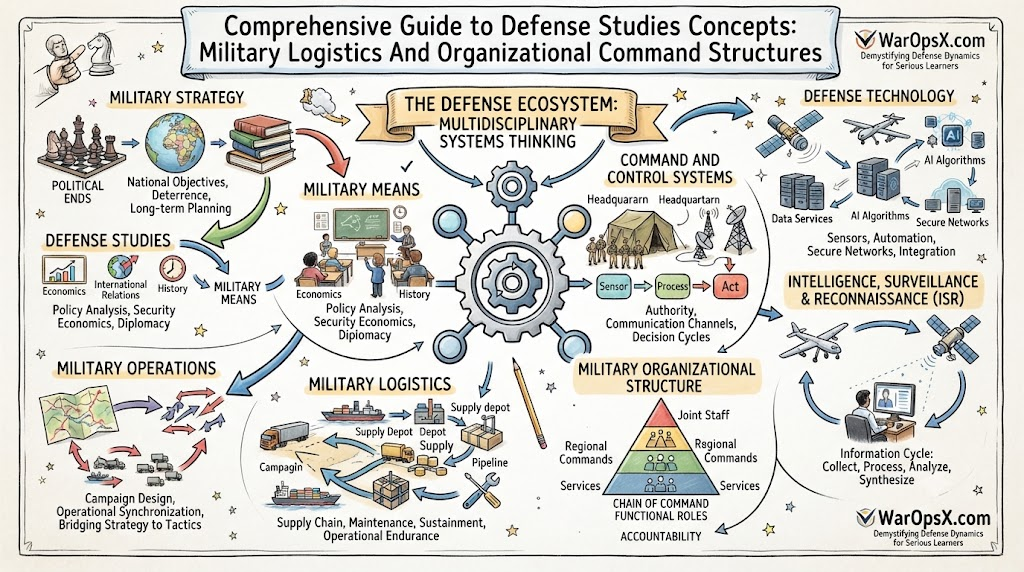
How Military Strategy, Operations, Logistics and Technology Connect
Comprehensive defense studies require a disciplined systems-thinking framework that links every individual subject into a unified analytical structure:
$$\text{Strategy} \longrightarrow \text{Operations} \longrightarrow \text{Organization} \longrightarrow \text{Logistics} \longrightarrow \text{Technology} \longrightarrow \text{Information} \longrightarrow \text{Decision-Making}$$
Strategic leadership establishes core national objectives, which operational planners translate into actionable joint campaigns managed by structured military organizations. These operational structures cannot function without resilient logistics pipelines, which depend on mature technological tools and verified intelligence streams to inform human decision-making. Studying these elements in isolation creates dangerous analytical blind spots, whereas analyzing their interconnected relationships reveals how defense institutions maintain balance, adapt to external disruptions, and secure national objectives over extended horizons.
| Area | What It Covers | Why It Matters |
| Military Strategy | National objectives, deterrence, resource balance, and long-term planning | Connects defense capabilities directly with political and policy goals |
| Defense Studies | Multidisciplinary policy, economics, geography, and security studies | Delivers broad context beyond hardware specifications and combat tools |
| Military Operations | Theater campaign planning, force readiness, and joint coordination | Bridges high-level political strategy with field-level operational execution |
| Military Logistics | Supply chain networks, maintenance pipelines, fuel, and sustainment | Guarantees operational readiness, deployment tempo, and force sustainability |
| Command and Control | Authority structures, communication lines, and situational assessment | Enables synchronized coordination and rapid organizational decision cycles |
| Defense Technology | Artificial intelligence, cyber architecture, sensors, and autonomous systems | Expands operational reach while demanding strict human oversight and maintenance |
| Military History | Historical campaigns, institutional changes, and strategic doctrines | Supplies empirical case studies on operational adaptation and systemic errors |
| Organizational Structure | Chain of command, service branches, formations, and joint task forces | Establishes administrative clarity, accountability, and operational discipline |
| Multidomain Operations | Interdependence across air, land, maritime, space, and cyber domains | Prevents domain isolation and addresses complex multi-environment vulnerabilities |
| ISR Systems | Collection pipelines, technical analysis, and strategic risk monitoring | Supplies verified situational awareness to support sound strategic decisions |
Real-Life Scenarios and Structural Realities
- An advanced air defense network experiences severe operational degradation because regional resupply convoys cannot deliver replacement radar coolant across unsecured ground transit lines.
- A joint military headquarters loses theater-wide situational awareness after an adversary disrupts commercial communications satellites, forcing commanders to fall back on decentralized command doctrines and redundant radio relays.
- A comprehensive national defense strategy fails to deter regional destabilization because domestic budget deficits force political leaders to cancel critical naval maintenance overhauls, stranding vessels in port.
- Strategic analysts successfully predict an adversary’s operational maneuvers by tracking abnormal rail transport schedules, commercial fuel distribution shifts, and blood supply repositioning rather than relying on frontline troop movements alone.
Methodical Study Framework for Defense Systems Analysis
- Step A: Establish foundational terminology by studying basic defense concepts, core strategic theories, and civil-military governance models.
- Step B: Explore military history to analyze how historical institutions handled operational logistics, technological shifts, and unexpected strategic surprises.
- Step C: Study command hierarchy and organizational structures to understand how different armed service branches organize, train, and maintain accountability.
- Step D: Examine the operational level of defense, focusing on theater campaign design, resource management, and multi-unit coordination concepts.
- Step E: Investigate logistics and sustainment pipelines, evaluating how transportation bottlenecks, fuel demands, and maintenance cycles constrain operational planning.
- Step F: Analyze technological integration, assessing how autonomous software, secure data networks, and sensor architectures interface with human command systems.
- Step G: Synthesize cross-domain concepts by evaluating multidomain operations, ISR cycles, and unified grand strategy within simulated policy case studies.
Who Can Benefit From Independent Defense Education?
Academic students, international relations researchers, public policy analysts, and national security scholars use structured educational resources to understand the practical mechanics of statecraft and defense policy. Military history enthusiasts discover objective frameworks for evaluating historical campaigns beyond simplistic battlefield narratives, examining the deep logistical and industrial networks that determined historical outcomes. Technology developers, systems engineers, and cyber security researchers gain clear operational context, helping them understand how software, sensor arrays, and unmanned platforms must integrate into established military command hierarchies. By avoiding tactical combat instructions and partisan rhetoric, structured defense platforms provide a professional, accessible knowledge destination for anyone seeking to understand modern security affairs.
Why Understanding Defense as a System Matters
National defense readiness is fundamentally an emergent property of a complex, adaptive socio-technical system, rather than the simple sum of an armed force’s individual weapon platforms. True defensive capability depends entirely on the harmonious alignment of well-trained personnel, ethical leadership, sound strategic doctrine, modern technology, secure information networks, resilient logistics pipelines, and responsive political governance. If any single component experiences structural failure—whether through fractured logistical supply chains, corrupted communications networks, or ambiguous operational chains of command—the entire national defense architecture risks systemic failure during a crisis. Cultivating a disciplined systems-thinking perspective ensures that analysts evaluate national security comprehensively, recognizing that organizational resilience and institutional adaptability are the ultimate foundations of lasting sovereign stability.
Common Analytical Mistakes to Avoid
- Conflating tactical combat successes with sound, long-term national military strategy.
- Viewing advanced military hardware as a standalone solution for systemic institutional deficiencies.
- Ignoring logistical supply lines, depot maintenance capacity, and fuel constraints when evaluating force capabilities.
- Evaluating national security topics through an isolated single-domain lens rather than a multidomain perspective.
- Treating military history as simple trivia instead of examining underlying organizational and operational decisions.
- Overlooking the vital role of civilian political oversight, domestic economic policy, and international alliances in defense planning.
- Assuming that rapid technological automation eliminates the fundamental friction and uncertainty of crisis environments.
- Disregarding the critical importance of command hierarchy, organizational culture, and administrative clarity in decision-making.
Frequently Asked Questions
1. What is the fundamental difference between military strategy and military tactics?
Military strategy focuses on achieving broad national policy goals through long-term resource allocation, international diplomacy, deterrence, and comprehensive defense planning. In contrast, tactics deal with the localized deployment, maneuver, and management of specialized units during specific field engagements. Strategy determines the broader political purpose of defense assets, while tactics govern local actions within specific operational zones.
2. Why is logistics considered the most critical factor in defense readiness?
Without consistent fuel deliveries, spare parts supply chains, medical infrastructure, and depot-level maintenance networks, advanced defense forces quickly lose their operational utility. Logistical constraints dictate how far units can travel, how long operations can endure, and how rapidly organizations recover from disruption. Operational readiness relies fundamentally on sustained material replenishment over time.
3. How do modern multidomain operations differ from traditional joint warfare?
Traditional joint operations coordinated actions between separate land, sea, and air branches, but modern multidomain operations unify these physical spheres with outer space, cyberspace, and the electromagnetic spectrum. Modern multidomain doctrine addresses cross-domain interdependencies, where digital network disruptions in cyberspace instantly degrade terrestrial radar surveillance, naval logistics pipelines, and airborne navigation capabilities.
4. What primary role does command and control play in defense organizations?
Command and control frameworks establish the lawful authority, organizational hierarchy, and communication channels necessary for leaders to direct distributed formations effectively. C2 systems ensure that critical information flows accurately from operational units to decision-makers, who then issue coherent strategic guidance that subordinate leaders can interpret, execute, and adapt under changing conditions.
5. Why should defense studies students examine military history?
Historical analysis provides an empirical foundation for understanding how strategic decisions, organizational designs, geographic constraints, and supply disruptions impact defense systems over time. Examining past campaigns helps researchers identify recurrent systemic vulnerabilities, analyze organizational adaptations during crises, and avoid repeating doctrinal miscalculations that previously undermined national security posture.
6. What does the operational level of defense encompass?
The operational level links high-level national strategy with specific field-level unit operations. Operational planners design campaigns, schedule multi-unit maneuvers, allocate logistical sustainment, and coordinate joint forces across theater commands. This discipline ensures that individual actions work together to fulfill national defense goals without descending into micromanaged tactical procedures.
7. How does artificial intelligence influence modern defense decision-making?
Artificial intelligence processes massive sensor datasets, detects anomalies in intelligence feeds, models logistical bottlenecks, and provides decision-support analysis for human leaders. However, automated software requires robust cybersecurity protection, high-quality data inputs, and strict human oversight to prevent operational errors, ensure institutional accountability, and maintain ethical standards in crisis scenarios.
8. What is the standard process behind the intelligence cycle?
The intelligence cycle is a structured analytical methodology consisting of collection, processing, multidisciplinary analysis, formal assessment, and decision-support dissemination. Raw signals, imagery, and open-source data are gathered, verified for technical accuracy, evaluated against current geopolitical patterns, and synthesized into actionable briefings that assist civilian and defense leaders in strategic risk management.
9. Why is a multidisciplinary approach essential when analyzing national defense?
Military capabilities do not exist in an institutional vacuum; they are shaped by international law, domestic public policy, industrial manufacturing capacity, economic trade alliances, and geographic realities. Studying defense solely through equipment inventories ignores the political, legal, and financial pressures that dictate whether a nation can sustain its armed forces during an extended emergency.
10. How does organizational structure affect operational efficiency in armed forces?
A clear organizational hierarchy defines lines of authority, eliminates duplicate administrative efforts, and establishes personal accountability throughout the chain of command. When administrative roles, command responsibilities, and reporting relationships are clearly delineated, critical information travels quickly without distortion, enabling defense establishments to make timely, disciplined, and coordinated decisions during complex international crises.
11. What is the role of deterrence within modern defense strategy?
Deterrence is the practice of maintaining credible defense capabilities, reliable strategic alliances, and clear political resolve to convince potential adversaries that the costs of aggression far outweigh any possible benefits. Effective deterrence relies heavily on visible readiness, resilient economic infrastructure, and reliable intelligence systems that together demonstrate an unmistakable ability to resist destabilizing actions.
12. Why does WarOpsX focus on educational rather than tactical content?
WarOpsX emphasizes strategic education, operational systems, technological analysis, and institutional history to help students, researchers, and policy analysts understand defense through an academic lens. By avoiding tactical combat instructions and weapon-handling guides, the platform maintains a scholarly, analytical environment focused entirely on defense systems, operational management, and global security architecture.
Conclusion
Understanding modern defense requires looking past individual weapon systems to analyze the broader architecture of strategy, logistics, command systems, and multidomain operational planning. A comprehensive approach connects historical experience, organizational discipline, and emerging technological capabilities, showing learners how policy objectives translate into long-term defensive readiness. By adopting a systems-thinking mindset, students, researchers, and policy analysts can move beyond isolated tactical details and develop an objective, nuanced understanding of how modern defense institutions function, adapt, and safeguard national stability.
Leave a Reply