Integrating Automated Security Testing Pipelines Using DevSecOps Certified Professional (DSOCP) Industry Standards
Introduction
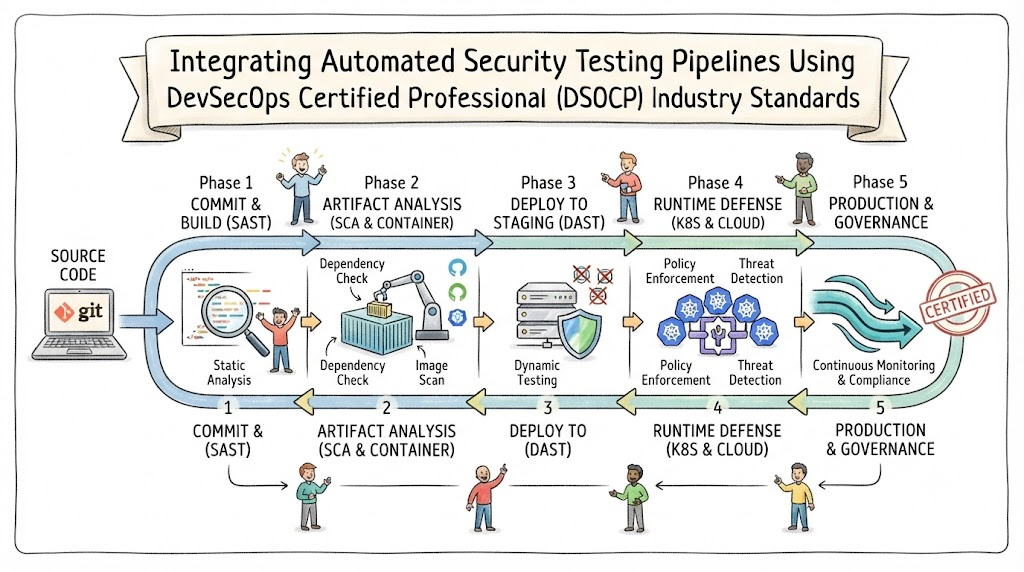
The DevSecOps Certified Professional (DSOCP) is an industry-recognized benchmark designed to bridge the operational gap between fast software delivery, robust cloud architecture, and strict security compliance. This guide is crafted for working engineers, platform architects, and technology leaders who want to eliminate the friction caused by treating security as a late-stage gatekeeper. Within modern software engineering, security can no longer sit outside of the standard CI/CD lifecycle or cloud infrastructure automation.
As cloud-native architectures grow more complex, enterprises require engineers who understand automated risk mitigation, software supply chain verification, and continuous compliance enforcement. Pursuing specialized milestones—much like earning advanced credentials such as a Microsoft Certified Azure Solutions Architect Expert—demonstrates your capability to architect resilient, scalable systems that resist threats at enterprise scale. This comprehensive roadmap provides clear, unvarnished guidance to help you navigate your professional trajectory, select the right learning track, and make sound investments in your engineering career.
What is the DevSecOps Certified Professional (DSOCP)?
The DevSecOps Certified Professional (DSOCP) represents a hands-on, production-grade qualification that validates an engineer’s ability to embed security controls into every phase of the software delivery lifecycle. Rather than focusing on abstract policies or theoretical compliance frameworks, the credential tests your technical capacity to automate security testing within fast-moving continuous integration and deployment pipelines. It exists to solve the critical enterprise dilemma where rapid deployment schedules routinely bypass manual vulnerability reviews.
Earning this credential means demonstrating mastery over practical tooling, infrastructure protection, and policy-as-code automation. You learn to treat security findings as immediate operational feedback loops that developers and platform engineers can fix without halting delivery pipelines. The curriculum aligns directly with real-world enterprise architectures, showing you how to handle software supply chain threats, protect production container clusters, and manage cloud secrets systematically.
Who Should Pursue DevSecOps Certified Professional (DSOCP)?
The credential is engineered specifically for practicing DevOps engineers, Site Reliability Engineers (SREs), cloud infrastructure professionals, and software developers transitioning into platform ownership. Traditional security analysts and penetration testers who need to acquire automated coding and pipeline integration skills will also find it highly relevant. Whether you are troubleshooting container runtimes or building continuous deployment pipelines, this qualification addresses the daily operational realities of your work.
Experienced senior engineers and technical leads benefit by establishing standardized security patterns across their delivery teams, while mid-level professionals gain a competitive edge by mastering high-demand automation disciplines. For engineering leaders and delivery managers, the credential provides the technical framework needed to drive cultural shifts toward shared accountability. This expertise is globally applicable across distributed cloud teams and especially valuable in high-growth technology markets where organizations must meet stringent compliance mandates while shipping software quickly.
Why DevSecOps Certified Professional (DSOCP) is Valuable
The accelerating adoption of containerized microservices, multi-cloud platforms, and open-source dependencies has made automated security an operational necessity. Traditional, perimeter-based security fails in environments where code is committed and pushed to production dozens of times a day. As organizations transition to platform engineering models, teams that master security automation avoid the expensive rollbacks, deployment delays, and regulatory penalties that occur when flaws are discovered after release.
This qualification delivers lasting career durability because it teaches architectural principles rather than ephemeral vendor interfaces. You master root-cause mitigation, threat modeling, and defensive engineering patterns that remain relevant across changing technology stacks and tool ecosystems. Investing your learning time into these core capabilities generates immediate returns by turning you into an engineer who can reduce risk, maintain delivery velocity, and lead high-stakes modernization initiatives.
DevSecOps Certified Professional (DSOCP) Certification Overview
The DevSecOps Certified Professional (DSOCP) assessment program is delivered through DevOpsSchool and administered directly on its official learning platform. It emphasizes rigorous technical assessments that evaluate an engineer’s capacity to build, secure, and monitor real-world delivery pipelines. Unlike multiple-choice exams that prioritize memorization, this evaluation approach tests whether a candidate can fix vulnerable configurations, automate code analysis, and configure runtime protections in live simulation environments.
Candidates are assessed across real-world operational challenges, including container security hardening, cloud configuration audits, pipeline gate enforcement, and secret protection. The program requires individuals to show functional ownership over secure software lifecycles, ensuring they can implement these practices immediately within their daily workflows. The structured learning modules make it accessible to working professionals while maintaining a strict standard for practical technical execution.
DevSecOps Certified Professional (DSOCP) Certification Tracks & Levels
The certification framework is organized into distinct proficiency levels to support clear career progression, moving from foundational security principles to complex enterprise orchestration. The Foundation level introduces the fundamental tools, cultural philosophies, and basic integration techniques required to understand software vulnerabilities and pipeline automation. It ensures engineers possess a common vocabulary and baseline operational capability before moving to advanced configurations.
The Professional level, anchored by the DSOCP credential, targets production engineers responsible for designing end-to-end security workflows, managing infrastructure-as-code policies, and hardening containerized workloads. Beyond this level, Advanced and Specialization tracks allow senior engineers to branch into adjacent domains such as Site Reliability Engineering, cloud platform operations, financial management, and automated intelligence. This layered structure allows you to build depth within DevSecOps while expanding horizontally into broader architectural disciplines.
Complete DevSecOps Certified Professional (DSOCP) Certification Table
| Track | Level | Who it’s for | Prerequisites | Skills Covered | Recommended Order |
| DevSecOps Core | Foundation | Junior DevOps, QA, Software Developers | Basic Linux, Git, and Shell scripting | Vulnerability scanning, basic CI/CD, secret hygiene | 1 |
| DevSecOps Core | Professional (DSOCP) | DevOps, Cloud, and Systems Engineers | CI/CD automation, Docker, basic cloud usage | SAST, DAST, SCA, container security, policy-as-code | 2 |
| DevSecOps Advanced | Expert | Principal Engineers, Security Architects | Advanced CI/CD, Kubernetes, cloud security | Runtime security, eBPF, threat modeling, supply chain | 3 |
| Cloud Security | Professional | Cloud Engineers, Infrastructure Leads | Cloud platform administration, Terraform | IAM policies, cloud posture management, KMS | 4 |
| SRE & Resilience | Professional | Site Reliability Engineers, Ops Leads | Observability stacks, Linux internals | Incident response, chaos engineering, SLIs/SLOs | 5 |
| FinOps | Associate | Engineering Managers, Platform Leads | Cloud cost models, infrastructure lifecycle | Cloud cost optimization, tagging policies, governance | 6 |
Detailed Guide for Each DevSecOps Certified Professional (DSOCP) Certification
DevSecOps Certified Professional (DSOCP) – Foundation Level
What it is
The Foundation credential validates your fundamental understanding of secure pipeline workflows, basic vulnerability detection, and DevSecOps cultural principles. It confirms that you can participate effectively in daily deployment operations without introducing common operational security flaws.
Who should take it
This entry-level track is suitable for junior developers, quality assurance automation engineers, and system administrators with one to two years of technical experience who want to transition into secure DevOps engineering roles.
Skills you’ll gain
- Understanding software vulnerabilities and the OWASP Top 10 framework
- Configuring automated secret scanning inside Git workflows
- Running open-source dependency checks within simple build processes
- Implementing baseline Linux and SSH system hardening measures
- Understanding common automated testing gates within CI/CD engines
Real-world projects you should be able to do
- Configure pre-commit hooks to prevent private cryptographic keys and credentials from entering version control
- Set up an automated build job that flags outdated, vulnerable open-source dependencies
- Apply secure base configuration templates to virtual machine operating system images
Preparation plan
- 7–14 days: Review core security definitions, the OWASP Top 10 list, and basic Git commit workflows.
- 30 days: Spend hands-on time setting up simple automation jobs in your preferred CI/CD platform and testing vulnerability scanners.
- 60 days: Build end-to-end demo repositories incorporating static analysis and container hygiene checks on public platforms.
Common mistakes
- Relying exclusively on theoretical documentation without practicing hands-on pipeline configurations
- Memorizing vulnerability names rather than understanding how to fix insecure code or dependencies
- Treating security as a purely separate manual review phase instead of an automated pipeline step
Best next certification after this
- Same-track option: DevSecOps Certified Professional (DSOCP)
- Cross-track option: Cloud Platform Operations Associate
- Leadership option: Agile Delivery and Engineering Team Lead
DevSecOps Certified Professional (DSOCP) – Professional Level
What it is
The Professional level is the core DSOCP certification validating that an engineer can build automated, secure pipelines and protect production workloads. It verifies that you can integrate static and dynamic security tools directly into enterprise software deployment pipelines.
Who should take it
This level is designed for working DevOps engineers, platform practitioners, and cloud infrastructure specialists with three or more years of experience who manage delivery infrastructure and production workloads.
Skills you’ll gain
- Implementing Static Application Security Testing (SAST) and Dynamic Application Security Testing (DAST)
- Designing Software Composition Analysis (SCA) workflows to generate Software Bills of Materials (SBOM)
- Enforcing Policy-as-Code using automated validation frameworks across infrastructure files
- Hardening container images, minimizing attack surfaces, and scanning production registries
- Managing centralized secrets across multi-tier application delivery architectures
Real-world projects you should be able to do
- Construct a complete CI/CD pipeline that blocks release builds failing defined security quality gates
- Build an automated container scanning system that tags and rejects vulnerable base images in registries
- Enforce automated compliance policies on infrastructure-as-code templates prior to cloud provisioning
Preparation plan
- 7–14 days: Focus entirely on tool integration exercises, review pipeline syntax, and practice policy rule creation.
- 30 days: Build out full test pipelines combining static analysis, dynamic scanning, and automated container audits.
- 60 days: Implement production-grade scenarios involving secret managers, custom policy enforcement, and live deployment gates.
Common mistakes
- Allowing automated pipeline scans to generate high false-positive alerts that block active engineering work
- Hardcoding access credentials inside automation scripts during initial pipeline setup
- Neglecting runtime security protections and focusing exclusively on pre-commit and build-time scans
Best next certification after this
- Same-track option: DevSecOps Certified Expert (DSOCE)
- Cross-track option: Site Reliability Engineering Professional (SREP)
- Leadership option: Technical Director of Infrastructure and Platform Security
DevSecOps Certified Professional (DSOCP) – Advanced Level
What it is
The Advanced Level validates your mastery over complex cloud-native architectures, enterprise governance, and runtime attack containment. It confirms that you can design secure platform foundations across distributed container clusters and hybrid infrastructure environments.
Who should take it
Senior engineers, platform architects, and principal infrastructure specialists responsible for multi-tenant environments, regulatory compliance, and cross-team security architecture should take this track.
Skills you’ll gain
- Deploying kernel-level runtime protection and threat detection mechanisms using modern tracing tools
- Building automated supply chain verification systems using cryptographic image signing
- Architecting zero-trust network policies within distributed container orchestration platforms
- Implementing continuous compliance auditing across enterprise-scale multi-account cloud topologies
- Designing resilient incident recovery playbooks and automated isolation triggers for compromised systems
Real-world projects you should be able to do
- Implement cryptographic container signing and admission controllers that reject unsigned cluster workloads
- Deploy an automated kernel-level monitoring solution to identify and isolate anomalous container behavior
- Build an automated security response system that isolates compromised virtual resources without human intervention
Preparation plan
- 7–14 days: Deep-dive into container admission controllers, cryptographic verification systems, and kernel-level event tracing.
- 30 days: Build and run hands-on lab environments that execute container attacks and validate automated runtime alerts.
- 60 days: Architect a multi-cluster deployment platform that enforces zero-trust communication and end-to-end supply chain verification.
Common mistakes
- Failing to test how runtime security enforcement agents impact cluster performance under heavy operational load
- Overcomplicating admission control policies, causing cascading deployment failures across non-production environments
- Treating runtime protection as a complete replacement for robust build-phase hygiene and supply chain analysis
Best next certification after this
- Same-track option: Enterprise Security Architecture Fellow
- Cross-track option: Cloud Native Platform Engineering Specialist
- Leadership option: Chief Information Security Officer (CISO) Executive Track
Choose Your Learning Path
DevOps Path
The DevOps learning path establishes the baseline automation, continuous integration, and infrastructure provisioning skills required by modern software teams. You focus on building fast, reliable release systems using code repositories, automated testing pipelines, and declarative infrastructure-as-code patterns. This track provides the core foundation upon which security controls and governance policies must eventually be applied. Mastering this path ensures that you can balance deployment speed with system stability before introducing advanced defensive tooling.
DevSecOps Path
The DevSecOps learning path takes traditional continuous delivery practices and integrates automated risk mitigation, software composition auditing, and policy enforcement directly into them. You specialize in moving defensive testing into the earliest stages of software development, giving developers immediate feedback on code vulnerabilities and insecure dependencies. This track teaches you to configure security gates that enforce compliance without slowing team delivery velocity. It is the optimal path for engineers dedicated to securing cloud-native delivery pipelines.
SRE Path
The Site Reliability Engineering path concentrates on system availability, resilience, observability, and programmatic incident mitigation. You learn to manage services through service level indicators, error budgets, and distributed application tracing across dynamic infrastructures. This path complements security practices by showing you how to build fault-tolerant architectures that continue operating under stress or intentional denial-of-service events. It transforms operations engineers into software professionals who manage infrastructure stability through automation.
AIOps Path
The AIOps path focuses on using machine learning algorithms and advanced data heuristics to analyze massive volumes of operational metrics, logs, and trace telemetry. You learn to configure systems that detect anomalies, correlate dispersed infrastructure alerts, and automate root-cause remediation before human operators can intervene. This track enhances your operational security capacity by surfacing subtle attack signatures and behavioral shifts that static monitoring rules fail to catch. It is designed for engineers seeking to modernize enterprise observability and operational response systems.
MLOps Path
The MLOps path specializes in standardizing and automating the complete operational lifecycle of machine learning models in production environments. You master continuous training pipelines, model registry management, data drift monitoring, and secure serving infrastructure. This track addresses critical vulnerabilities specific to artificial intelligence pipelines, such as training data poisoning, model evasion attacks, and insecure endpoint exposure. It is the ideal direction for engineers operating at the intersection of production systems and machine intelligence.
DataOps Path
The DataOps path applies agile development and continuous integration methodologies to complex data analytics pipelines and distributed processing platforms. You focus on automated data quality validation, metadata tracking, secure schema migrations, and real-time streaming operations. This track helps organizations secure sensitive data repositories, enforce row-level access controls, and maintain compliance across distributed data lakes. It bridges the gap between infrastructure automation and enterprise business intelligence architectures.
FinOps Path
The FinOps path blends cloud infrastructure architecture, operational engineering, and financial accountability to eliminate unnecessary cloud expenditure. You learn to establish granular tagging strategies, automate resource rightsizing, configure anomaly-based cost alerts, and manage enterprise discount commitments. This discipline ensures that engineering teams understand the financial impact of their architectural decisions and resource allocation choices. It prepares technical professionals to optimize cloud infrastructure costs without compromising application performance or operational security.
Role to Recommended DevSecOps Certified Professional (DSOCP) Certifications
| Role | Recommended Certifications | Primary Focus Areas |
| DevOps Engineer | DSOCP Professional, Cloud Platform Associate | CI/CD security integration, automated image scanning, secret hygiene |
| SRE | DSOCP Professional, SRE Practitioner | Observability, automated incident isolation, runtime policy enforcement |
| Platform Engineer | DSOCP Advanced, Cloud Platform Professional | Internal developer platform hardening, admission controllers, zero-trust |
| Cloud Engineer | DSOCP Professional, Cloud Security Architect | Cloud infrastructure policies, IAM configuration, secure networking |
| Security Engineer | DSOCP Advanced, Enterprise Threat Specialist | Automated penetration testing, vulnerability remediation, supply chain security |
| Data Engineer | DSOCP Foundation, DataOps Specialist | Data pipeline security, access policy automation, storage encryption |
| FinOps Practitioner | DSOCP Foundation, FinOps Professional | Cost governance, resource utilization tracking, infrastructure lifecycle |
| Engineering Manager | DSOCP Foundation, Agile Leadership Master | DevSecOps culture adoption, team compliance metrics, risk management |
Next Certifications to Take After DevSecOps Certified Professional (DSOCP)
Same Track Progression
Deepening your specialization within the DevSecOps track involves mastering advanced container orchestration security, runtime threat analysis, and automated software supply chain verification. Progressing toward expert-level certifications allows you to move beyond basic pipeline integration into architecting unified enterprise defense platforms. In this advanced tier, you configure custom admission controllers, implement kernel-level runtime protection using eBPF, and establish secure software artifact provenance. This progression solidifies your standing as an authoritative enterprise security architect capable of protecting complex, multi-tenant cloud ecosystems.
Cross-Track Expansion
Broadening your technical expertise across adjacent disciplines prevents professional stagnation and prepares you for broad platform architecture responsibilities. Pairing your DSOCP qualification with Site Reliability Engineering or Cloud Infrastructure certifications establishes you as an engineer who understands both operational durability and defensive system design. You can also explore specialized tracks like FinOps to master cloud financial optimization, or DataOps to secure enterprise data processing pipelines. This multi-disciplinary foundation makes you uniquely capable of designing scalable systems that are stable, cost-effective, and fully compliant.
Leadership & Management Track
Transitioning from deep hands-on execution into engineering management requires translating technical security capabilities into clear business risk mitigation strategies. Moving toward technology leadership credentials validates your capacity to build engineering cultures rooted in shared accountability and collaborative delivery. In these roles, you will define enterprise-wide compliance roadmaps, manage toolchain budgets, and align security automation initiatives with overarching product delivery goals. This career track equips you to direct distributed engineering groups, mentor team leads, and effectively communicate technical priorities to executive boards.
Training & Certification Support Providers for DevSecOps Certified Professional (DSOCP)
DevOpsSchool provides comprehensive, enterprise-grade training programs and hands-on laboratory environments specifically built for engineers pursuing the DSOCP credential. Their curriculum emphasizes real-world deployment challenges, interactive pipeline construction, and practical toolchain mastery under the guidance of seasoned production professionals. Learners receive step-by-step mentoring, practical project assignments, and continuous assistance to help them implement modern security practices within production environments.
Cotocus specializes in delivering tailored corporate upskilling and professional technical consulting, focusing on infrastructure modernizations and security automation frameworks. Their interactive enablement programs are structured to help development and operations teams integrate defensive controls directly into active delivery workflows. Through practical lab assignments and architectural mentoring, Cotocus helps engineers master complex continuous integration and deployment pipelines.
Scmgalaxy functions as a community-driven knowledge base and specialized training platform catering to version control, release engineering, and automated software delivery. It provides engineers with practical learning tutorials, pipeline automation scripts, and technical frameworks designed to enhance day-to-day release quality. Their instructional resources help professionals navigate the operational mechanics of source code security and automated pipeline governance.
BestDevOps offers focused educational content, industry analysis, and curated learning roadmaps centered on platform reliability and modern infrastructure engineering. The platform helps technology professionals benchmark their technical skills and prepare for modern certification exams through structured, actionable guides. Its instructional material breaks down complex continuous delivery patterns into digestible operational steps suitable for working software professionals.
devsecopsschool.com provides specialized training exclusively focused on security automation, secure coding patterns, and compliance-as-code implementations. The school offers real-world laboratory exercises that simulate active enterprise development environments, requiring students to identify vulnerabilities and secure broken pipelines. Their courses prepare engineers to navigate contemporary supply chain threats, manage container runtimes, and meet enterprise governance expectations.
sreschool.com concentrates on educating infrastructure professionals in the core practices of reliability engineering, distributed monitoring, and systematic incident management. Its programs emphasize practical production resilience, showing candidates how to define service level indicators, manage error budgets, and automate disaster recovery. This training helps engineers bridge the operational gap between fast software updates and high platform availability.
aiopsschool.com delivers targeted instructional courses on applying artificial intelligence and machine learning analytics to enterprise infrastructure telemetry. Students learn how to deploy automated log correlation engines, configure dynamic anomaly detection systems, and streamline root-cause analysis across complex environments. The school equips engineers to manage high-volume event ecosystems with minimal manual intervention.
dataopsschool.com focuses its educational offerings on modernizing data pipeline operations through automated quality testing, secure provisioning, and agile workflows. Learners are guided through the complexities of managing distributed data processing systems, orchestrating analytical transformations, and securing persistent storage lakes. The school prepares technical personnel to deliver reliable, compliant data architectures across cloud environments.
finopsschool.com educates technical professionals and platform managers on cloud financial governance, resource allocation strategies, and architectural cost efficiency. The curriculum covers automated tagging frameworks, usage visibility systems, and waste elimination techniques that align engineering decisions with corporate financial objectives. Its training empowers engineers to design high-performance architectures that remain fiscally sustainable.
Frequently Asked Questions (General)
1. What makes modern engineering certifications valuable for experienced professionals?
They validate your practical capacity to solve real production challenges using current industry methodologies rather than outdated practices. A reputable credential acts as an objective benchmark of your abilities, signaling to employers that you can deliver tangible improvements to their deployment pipelines, infrastructure resilience, and system security from day one.
2. How difficult are professional-level platform certifications compared to academic exams?
Professional platform certifications are considerably more demanding because they focus on applied troubleshooting, system design, and live technical configurations. Memorizing definitions is insufficient; candidates must demonstrate hands-on familiarity with tooling, command-line environments, automation patterns, and complex infrastructure integrations.
3. What is the typical preparation time required for a professional engineering qualification?
Most working engineers spend between four and eight weeks preparing, dedicating roughly five to ten hours each week to hands-on labs and conceptual study. The exact timeframe depends heavily on your prior familiarity with Linux environments, automation scripts, and continuous integration engines.
4. Are foundational prerequisites strictly mandatory before attempting professional exams?
While not always administratively enforced, foundational knowledge in Linux, shell scripting, source control, and container fundamentals is practically essential. Attempting advanced certifications without these core prerequisites usually leads to conceptual gaps and difficulty completing practical, timed lab exercises.
5. How do hands-on lab assessments compare to multiple-choice questionnaires?
Hands-on lab assessments test an engineer’s ability to diagnose, configure, and verify operational systems in active environments, simulating true workplace conditions. Multiple-choice tests primarily measure recall and conceptual familiarity, which rarely guarantees that an individual can resolve real production incidents.
6. What is the expected return on investment for technical certifications?
The primary return comes from accelerated career progression, broader employment opportunities, and the ability to justify senior-level engineering compensation. Additionally, the structured preparation process fills knowledge gaps, allowing you to complete work projects faster and make fewer architectural errors.
7. How often should a practicing engineer update their certification portfolio?
Refreshing your core credentials every two to three years ensures your operational knowledge remains aligned with evolving platform tooling and enterprise deployment patterns. As old tools are replaced by modern automation frameworks, updated certifications prove that your skill set remains current and competitive.
8. Can technical certifications compensate for a lack of formal university credentials?
Yes, modern software engineering increasingly values demonstrable capability, practical execution, and problem-solving skills over traditional academic degrees. A strong track record of hands-on credentials, combined with public code repositories or practical project demonstrations, provides compelling evidence of your professional engineering competence.
9. How do cross-track certifications help long-term career growth?
Broadening your knowledge across disciplines like SRE, FinOps, and security prevents career siloing and prepares you for higher-level architectural responsibilities. Engineers who understand how security, system reliability, and cost management intersect can design far more resilient enterprise solutions.
10. What sequence should an engineer follow when accumulating multiple certifications?
Start with broad operating system and continuous integration fundamentals before pursuing deep domain specializations such as automated security or platform reliability. Once your primary specialty is well established, expand into governance, financial modeling, or system architecture based on your chosen career trajectory.
11. Why do enterprise employers prioritize certified candidates for critical roles?
Certified candidates reduce hiring uncertainty by demonstrating baseline technical competence that has been evaluated by an external standard. This validation gives managers confidence that new hires will require less onboarding time and can execute production changes safely.
12. How should candidates balance video coursework with hands-on lab practice?
Aim for a balance of roughly thirty percent conceptual study and seventy percent direct, keyboard-level configuration inside live terminal environments. Concepts only solidify when you encounter, diagnose, and resolve authentic configuration errors and broken deployment pipelines yourself.
FAQs on DevSecOps Certified Professional (DSOCP)
1. What core technical proficiencies are validated by the DSOCP credential?
The DSOCP credential certifies an engineer’s ability to integrate automated security tooling into every step of the continuous delivery lifecycle. It proves competence in running static code analyzers, automated dependency checkers, dynamic runtime vulnerability scanners, and container security tools. Furthermore, it validates that you can configure policy-as-code guardrails that prevent non-compliant infrastructure configurations from being provisioned to production environments.
2. How does the DSOCP certification differentiate itself from generic security courses?
Most traditional security qualifications focus heavily on manual network penetration testing, theoretical compliance auditing, or abstract risk frameworks. The DSOCP program concentrates entirely on automated, developer-friendly workflows within modern continuous integration and continuous deployment pipelines. It approaches security from an engineering perspective, prioritizing code-level fixes, container hardening, and automated pipeline gates over static checklists.
3. What foundational knowledge should I have before preparing for the DSOCP exam?
Candidates should possess comfortable working familiarity with standard Linux terminal navigation, Git version control workflows, and basic containerization concepts using Docker. You should also understand the fundamental stages of continuous delivery pipelines, such as compiling code, running tests, and managing build artifacts, along with some experience using cloud infrastructure platforms.
4. How does holding the DSOCP credential impact an engineer’s day-to-day work?
Professionals with this credential transition away from addressing security vulnerabilities through chaotic, last-minute emergencies prior to scheduled releases. Instead, they implement automated testing patterns that surface flaws directly to developers early in the development cycle, reducing operational friction and fostering shared security responsibility across teams.
5. Why is the DSOCP qualification relevant for organizations migrating to containerization?
Containerized platforms introduce unique operational vulnerabilities, including insecure public base images, elevated execution privileges, and exposed cluster communication paths. The DSOCP curriculum explicitly covers container image scanning, layer minimization, runtime monitoring, and admission control policies, ensuring engineers can protect modern cloud-native environments effectively.
6. How does completing the DSOCP prepare professionals for engineering leadership roles?
The certification trains engineers to view security as an enabler of delivery velocity rather than an operational roadblock, an essential mindset for modern technical leadership. Leaders who understand how to balance automated governance with deployment agility can design platform architectures that satisfy executive compliance requirements without slowing development teams.
7. Can system administrators without deep development experience succeed in the DSOCP program?
Yes, systems engineers and administrators can succeed provided they are willing to learn basic scripting, configuration file structuring, and pipeline automation syntax. The curriculum teaches security integration from a systems automation standpoint, making it accessible to infrastructure professionals looking to advance into modern platform engineering roles.
8. What makes the practical assessment approach of the DSOCP program so effective?
The program emphasizes hands-on implementation challenges rather than simple multiple-choice questions, requiring students to fix vulnerable systems directly. This practical evaluation ensures candidates can correctly diagnose misconfigurations, secure broken deployment scripts, and verify policy compliance within realistic production environments, building authentic operational competence.
Final Thoughts: Is DevSecOps Certified Professional (DSOCP) Worth It?
Investing your effort into the DevSecOps Certified Professional (DSOCP) program comes down to whether you want to remain a generalist infrastructure operator or evolve into an engineer who can solve complex, systemic software delivery challenges. In the current enterprise landscape, building a deployment pipeline that moves code quickly is only half the job. Building one that moves code quickly while automatically verifying integrity, minimizing vulnerability footprints, and enforcing regulatory boundaries is what defines senior technical professionals.
This credential demands disciplined, hands-on practice, and it will challenge you to think critically about how developers, operations teams, and security stakeholders interact. If you are prepared to spend time in terminal environments configuring scanners, fixing broken policies, and securing delivery workflows, the investment will directly elevate your engineering maturity. The industry does not need more gatekeepers who point out problems after the fact; it needs engineers who can build automated systems that prevent those problems from occurring in the first place. That is the exact capability this qualification validates.
Leave a Reply