DevOps Certified Professional (DCP) Certification Scope For Modern Software Delivery Pipeline Architecture
Introduction
The DevOps Certified Professional (DCP) credential is an industry-recognized engineering qualification designed to validate end-to-end automation, continuous delivery, and infrastructure management expertise. This guide serves working engineers, systems administrators, cloud architects, and technology leaders who require an objective breakdown of the credential before committing preparation time. Navigating modern software delivery requires more than superficial familiarity with scripting tools; it demands a solid understanding of architectural patterns, system reliability, and collaborative delivery cycles.
Modern career progression across software delivery ecosystems increasingly favors professionals who can break down operational silos while maintaining high deployment velocity. As organizations transition toward complex multi-cloud deployments and internal developer platforms, credentials that enforce hands-on execution carry measurable weight in technical evaluations. Whether you are transitioning from a traditional systems role or leveling up as a senior technical contributor, this analysis equips you with the syllabus depth, project expectations, and strategic roadmap needed to make sound professional development decisions.
What is the DevOps Certified Professional (DCP)?
The DevOps Certified Professional (DCP) represents an applied, engineering-centric standard built to bridge software development pipelines with enterprise infrastructure operations. It exists primarily because modern enterprises require technical staff who understand production constraints, failure modes, and automated governance rather than isolated tool operations. Instead of assessing memorized commands, this certification evaluates how effectively an engineer constructs resilient, observable, and fully automated deployment systems under real-world constraints.
In production environments, delivery speed cannot come at the expense of system resilience or operational security. The curriculum reflects this principle by immersing candidates in real-world scenarios, including pipeline recovery, deployment rollback mechanisms, automated security policy gates, and distributed release orchestration. By mirroring standard enterprise delivery workflows, the credential validates that an engineer can step into an active development cycle and immediately contribute to stable, production-grade automation.
Who Should Pursue DevOps Certified Professional (DCP)?
This certification is designed for a broad spectrum of technical practitioners who build, ship, and operate enterprise software. Software engineers seeking to own runtime infrastructure, system administrators modernizing legacy environments, and site reliability engineers looking to formalize their automation practices gain direct technical value. Additionally, quality assurance leads moving toward continuous testing automation, cloud security analysts integrating shift-left controls, and data engineers orchestrating analytical pipelines find applicable foundational principles within the syllabus.
From an experience standpoint, early-career engineers with fundamental Linux and networking skills can use the program to build operational confidence. Senior engineers and technical leads leverage it to standardize deployment practices across distributed teams and eliminate operational debt. Across major engineering hubs in India as well as global enterprise organizations, engineering leaders look for this profile to reduce ramp-up times on large-scale infrastructure transformation programs.
Why DevOps Certified Professional (DCP) is Valuable
Enterprise infrastructure has evolved rapidly from static virtual servers to dynamic, event-driven, and platform-mediated environments. In this fast-changing climate, tool-specific certifications often become obsolete as individual vendor platforms evolve or fall out of enterprise favor. The DevOps Certified Professional (DCP) counters this risk by focusing on immutable operational paradigms: continuous integration, declarative configuration management, feedback observability loops, and infrastructure immutability.
Mastering these foundational architectural concepts allows an engineer to adapt across cloud platforms and proprietary tooling ecosystems. As organizations streamline operational headcounts and consolidate development workflows, engineers with verified, full-lifecycle delivery capabilities remain consistently in demand. The return on investment lies in long-term career durability, shorter development lead times, and the validated technical capability to minimize production downtime during critical service migrations.
DevOps Certified Professional (DCP) Certification Overview
The program is structured through a standardized curriculum maintained on official training portals. Assessments prioritize hands-on problem resolution, infrastructure build exercises, and scenario analysis over simple multiple-choice evaluations. Candidates must demonstrate competence in constructing automated pipelines, provisioning virtual environments using code, and troubleshooting broken cluster states.
The examination structure holds candidates accountable for complete system integrity. Ownership of the certification rests with dedicated operational councils who update curriculum requirements periodically to reflect changing security mandates and modern release architectures. Candidates are assessed against production benchmarks, ensuring that achieving a passing score represents genuine readiness to deploy enterprise-grade platforms.
DevOps Certified Professional (DCP) Certification Tracks & Levels
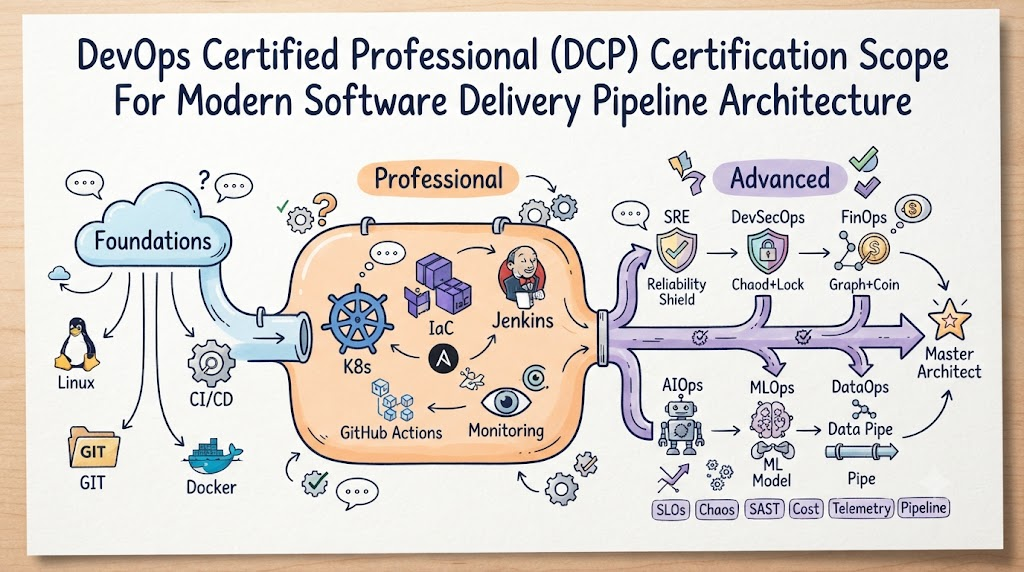
Professional development within this domain follows a progressive tier structure designed to accompany an engineer throughout their career. The foundational track emphasizes system administration, operational basics, version control, and scripting hygiene. This stage provides the baseline literacy needed to read pipeline configurations, debug container definitions, and maintain baseline system health.
The professional tier moves deeper into integration architectures, configuration automation, artifact management, and automated release policies. The advanced track demands mastery over multi-tenant cluster management, platform reliability, deep continuous profiling, and enterprise governance. Complementary specialization tracks—including security integration, site reliability engineering, infrastructure financial management, and data operations—allow senior practitioners to align their core operational knowledge with company-specific needs.
Complete DevOps Certified Professional (DCP) Certification Table
| Track | Level | Who it’s for | Prerequisites | Skills Covered | Recommended Order |
| Foundations | Associate | Junior Admins, Developers, QA | Linux fundamentals, Git basics, Shell scripting | Linux administration, Git workflows, Basic CI/CD, Container basics | Step 1 |
| Core Delivery | Professional | DevOps Engineers, SREs, Cloud Admins | 1-2 years infrastructure or development experience | Declarative pipelines, Docker, Kubernetes, Terraform, Ansible | Step 2 |
| Platform Operations | Advanced | Senior Engineers, Platform Specialists | Professional tier completion or equivalent experience | Microservices release orchestration, Helm, Service Mesh, Monitoring | Step 3 |
| Systems Reliability | Professional | SREs, Systems Engineers | Core delivery proficiency, Production operations experience | SLI/SLO definition, Incident response, Distributed tracing, Chaos testing | Step 4 (Branch) |
| Security Integration | Professional | DevSecOps, Cloud Security Engineers | Pipeline knowledge, Basic application security principles | SAST/DAST automation, Container image scanning, Secret management, OPA | Step 4 (Branch) |
| Infrastructure Finance | Specialist | Cloud Economists, Technical Leads | Cloud architecture, Cost center allocation awareness | Cloud cost attribution, Unit economics, Idle resource reclamation | Step 4 (Branch) |
| Analytical Systems | Specialist | Data Engineers, Pipeline Architects | Python, Database administration, Core CI/CD knowledge | Data pipeline testing, Schema migration automation, Feature store ops | Step 4 (Branch) |
Detailed Guide for Each DevOps Certified Professional (DCP) Certification
DevOps Certified Professional (DCP) – Foundation Tier
What it is
This level validates baseline systems literacy, automated version control practices, and core configuration hygiene. It confirms that a practitioner can operate safely within production environments without disrupting existing services.
Who should take it
Junior software developers, technical support staff, manual quality analysts, and early-career systems administrators who need to transition into automated operational roles.
Skills you’ll gain
- Automated source code workflows utilizing trunk-based branching strategies.
- Command-line Linux server configuration, permission models, and process management.
- Container construction, layer caching, and multi-stage container optimization.
- Basic build pipeline design using automated script triggers.
- Environment variable and credential isolation techniques.
Real-world projects you should be able to do
- Construct a secure, multi-stage container build for a web application to minimize surface area.
- Write operational shell scripts that parse web server logs, monitor memory thresholds, and alert administrators.
- Establish a continuous integration script that runs unit tests on push and rejects unformatted code.
Preparation plan
- 7–14 Days: Dedicate 4 hours daily to practical Linux command line operations, process signals, and Bash scripting exercises.
- 30 Days: Spend 2 hours daily building container files, running local containers, and mastering distributed version control mechanics.
- 60 Days: Work 1 hour daily systematically writing automated scripts, managing virtual machines locally, and configuring simple software pipelines.
Common mistakes
- Relying exclusively on graphical user interfaces instead of gaining fluent command-line speed.
- Ignoring Linux file permission structures, leading to unsafe execution practices.
- Treating container environments as long-running virtual machines instead of stateless application instances.
Best next certification after this
- Same-track option: DevOps Certified Professional (DCP) – Core Delivery Tier.
- Cross-track option: Cloud Security Integration Specialist.
- Leadership option: Technical Team Lead Operations Foundations.
DevOps Certified Professional (DCP) – Core Delivery Tier
What it is
This certification assesses the construction, deployment, and maintenance of end-to-end continuous delivery ecosystems. It validates hands-on expertise in declarative configuration, infrastructure provisioning, and container orchestration.
Who should take it
Practicing DevOps engineers, cloud administrators, systems programmers, and software engineers responsible for team release pipelines and deployment infrastructure.
Skills you’ll gain
- Infrastructure as Code (IaC) creation and state management using modern declarative tooling.
- Scalable multi-stage deployment pipeline construction with integrated rollback controls.
- Production Kubernetes cluster workload management, namespace isolation, and resource quotas.
- Automated configuration management across dynamic fleets of cloud instances.
- Centralized logging aggregation and alerting threshold design.
Real-world projects you should be able to do
- Provision a complete, multi-tier cloud environment from scratch using declarative configuration files.
- Construct an automated deployment pipeline implementing blue/green routing for zero-downtime application updates.
- Deploy a microservice application to a Kubernetes cluster with auto-scaling metrics, health probes, and ingress rules.
Preparation plan
- 7–14 Days: Focus 6 hours daily exclusively on writing declarative infrastructure templates, debugging state locks, and writing complex pipeline files.
- 30 Days: Dedicate 3 hours daily to container orchestration exercises, service networking troubleshooting, and automated configuration tasks.
- 60 Days: Spend 1.5 hours daily building comprehensive real-world applications, testing disaster recovery workflows, and refining automated release pipelines.
Common mistakes
- Storing unencrypted secrets, certificates, and access tokens inside source control repositories.
- Hardcoding network endpoints and configuration variables instead of decoupling application runtime parameters.
- Ignoring Kubernetes resource requests and limits, creating instability inside shared cluster environments.
Best next certification after this
- Same-track option: DevOps Certified Professional (DCP) – Advanced Platform Architecture.
- Cross-track option: Systems Reliability Engineering Practitioner.
- Leadership option: Cloud Operations Lead Specialist.
DevOps Certified Professional (DCP) – Advanced Platform Architecture
What it is
This credential certifies mastery over enterprise platform engineering, internal developer platforms (IDP), and complex multi-region delivery systems. It confirms an engineer’s ability to architect sustainable, multi-tenant application foundations.
Who should take it
Senior DevOps specialists, platform engineers, infrastructure architects, and principal systems engineers managing high-concurrency environments.
Skills you’ll gain
- Enterprise platform design utilizing self-service developer portals.
- Service mesh implementation for mutual TLS, deep observability, and advanced traffic shaping.
- Multi-region infrastructure disaster recovery strategy and active-active failover design.
- Policy-as-Code engine deployment to enforce compliance across all company delivery pipelines.
- Deep systems telemetry configuration incorporating distributed tracing and custom application metrics.
Real-world projects you should be able to do
- Implement a service mesh across multiple clusters to secure inter-service communication with mutual TLS and traffic splitting.
- Build a self-service developer interface that provisions compliant development workspaces and database backends automatically.
- Formulate and deploy declarative policy frameworks that block unapproved container images from running in production clusters.
Preparation plan
- 7–14 Days: Spend 6 hours daily analyzing production post-mortems, architecting active-active cloud systems, and fine-tuning service mesh networks.
- 30 Days: Dedicate 3 hours daily to writing Policy-as-Code rules, building internal platform abstractions, and configuring distributed tracing agents.
- 60 Days: Commit 2 hours daily to researching distributed system edge cases, testing complex failover topologies, and optimizing cluster costs.
Common mistakes
- Introducing unnecessary architectural complexity by adding tools that do not solve concrete business requirements.
- Overlooking identity federation, role-based access control, and audit logs during platform construction.
- Building brittle platform abstractions that fail to provide useful debugging information to product engineering teams.
Best next certification after this
- Same-track option: Enterprise Cloud Solutions Master.
- Cross-track option: Financial Infrastructure Specialist.
- Leadership option: Director of Platform Engineering Credential.
Choose Your Learning Path
DevOps Path
The standard DevOps path centers on accelerating the cycle time between writing code and operating it safely in production. Engineers master modern version control mechanics, immutable deployment pipelines, automated artifact registries, and infrastructure provisioning tools. This path is ideal for developers and systems engineers who want to eliminate manual handoffs and run stable, repeatable deployment systems.
DevSecOps Path
The DevSecOps track embeds security validation directly into automated delivery pipelines rather than treating it as a final audit gate. Engineers develop skills in static code analysis, software dependency vulnerability scanning, container security validation, dynamic runtime testing, and automated compliance policies. This path equips practitioners to safeguard modern applications without slowing down delivery velocity.
SRE Path
The Site Reliability Engineering path approaches operations as a software problem, prioritizing system resilience, scale, and uptime. Candidates master service level indicators (SLIs), service level objectives (SLOs), automated incident triage, error budgets, and chaos engineering practices. This path prepares engineers to run complex distributed architectures that withstand traffic spikes and downstream infrastructure failures.
AIOps Path
The AIOps path focuses on using intelligent algorithmic engines and automated telemetry ingestion to optimize modern system operations. Engineers learn to pipe complex logs, traces, and metrics into machine learning platforms to identify operational anomalies before outages occur. This path suits systems engineers who want to eliminate manual alert fatigue through predictive intelligence and automated event correlation.
MLOps Path
The MLOps specialization bridges traditional infrastructure operations with the lifecycle demands of machine learning models. Professionals master feature store deployment, automated model validation, continuous model retraining pipelines, tracking model drift, and running low-latency inference endpoints. This track is built for operational specialists and data teams who need to deploy and manage production machine learning workloads reliably.
DataOps Path
The DataOps track applies continuous integration, automated testing, and agile delivery principles to large-scale data systems. Engineers focus on automating complex data pipeline deployments, schema migrations, data quality assertion frameworks, and distributed processing environments. This path suits data engineers, platform specialists, and analytical systems administrators seeking to make enterprise data delivery reproducible and auditable.
FinOps Path
The FinOps path blends financial accountability with cloud infrastructure management to ensure business value in enterprise environments. Practitioners learn to attribute cloud infrastructure expenditures accurately, establish automated governance for idle resources, configure dynamic scaling policies, and align capacity planning with application performance requirements. This path serves senior technical leaders, platform architects, and cloud cost engineers seeking to maximize engineering output per dollar spent.
Role to Recommended DevOps Certified Professional (DCP) Certifications
| Role | Foundation Level | Professional Level | Advanced Specialization |
| DevOps Engineer | Foundation Tier | Core Delivery Tier | Advanced Platform Architecture |
| SRE | Foundation Tier | Core Delivery Tier | Systems Reliability Engineering |
| Platform Engineer | Foundation Tier | Core Delivery Tier | Advanced Platform Architecture |
| Cloud Engineer | Foundation Tier | Core Delivery Tier | Cloud Infrastructure Solutions |
| Security Engineer | Foundation Tier | Core Delivery Tier | DevSecOps Security Specialist |
| Data Engineer | Foundation Tier | Core Delivery Tier | DataOps Pipeline Specialist |
| FinOps Practitioner | Foundation Tier | Core Delivery Tier | Cloud Financial Management |
| Engineering Manager | Foundation Tier | Core Delivery Tier | Platform Strategy & Governance |
Next Certifications to Take After DevOps Certified Professional (DCP)
Same Track Progression
Staying on the core delivery path means pursuing advanced platform architecture and distributed systems mastery. Engineers in this tier focus on enterprise multi-cloud orchestration, platform self-service ergonomics, service mesh routing, and deep performance profiling. This trajectory prepares engineers for Principal DevOps Engineer and Chief Enterprise Architect positions.
Cross-Track Expansion
Broadening your technical domain involves adding complementary specializations like Site Reliability Engineering, Cloud Security, or Machine Learning Operations. Building multi-disciplinary expertise makes you a versatile technical contributor capable of managing complex cross-functional platform projects. This path suits lead engineers who collaborate closely with product teams, security organizations, and data science units.
Leadership & Management Track
Moving toward technical leadership means shifting focus from individual component administration to organizational technology strategy, governance, and delivery velocity. Relevant professional paths cover engineering leadership, cloud financial governance, technology risk management, and systems delivery transformation. This direction suits senior practitioners looking to transition into Engineering Manager, Director of Platform Engineering, or VP of Infrastructure roles.
Training & Certification Support Providers for DevOps Certified Professional (DCP)
DevOpsSchool
DevOpsSchool provides comprehensive training programs led by experienced industry mentors across major technology hubs. The curriculum emphasizes hands-on labs, production incident troubleshooting, and real-world delivery pipeline implementation. Learners work through enterprise scenarios covering container management, infrastructure as code, and continuous delivery toolchains. The institution provides dedicated mentor guidance, extensive training resources, and post-training support to help candidates build production-grade delivery skills.
Cotocus
Cotocus delivers specialized corporate and individual technology enablement programs with a strong focus on cloud-native delivery frameworks. Their instructional approach emphasizes live, instructor-led lab environments where students deploy container orchestration clusters, automated deployment pipelines, and configuration management scripts. The training programs are designed to upskill enterprise engineering groups, helping them adopt modern continuous integration standards and reduce operational friction.
Scmgalaxy
Scmgalaxy serves as an established technical knowledge community and enterprise training provider specializing in source code management, continuous integration, and modern delivery workflows. The platform provides structured courses along with an extensive repository of real-world templates, deployment patterns, and operational troubleshooting guides. Their programs help professionals transition smoothly from legacy build management approaches into declarative, modern delivery practices.
BestDevOps
BestDevOps focuses on practical career development and role-focused technical training across infrastructure operations and cloud orchestration. Their training programs cover end-to-end continuous integration pipelines, multi-cloud infrastructure provisioning, and container deployment security. Students work on hands-on deployment labs reflecting current enterprise architectural patterns, providing the operational familiarity needed for technical evaluations.
devsecopsschool.com
devsecopsschool.com focuses exclusively on shifting security practices left into modern software delivery pipelines. The curriculum covers static code analysis automation, dynamic runtime testing, container image scanning, secret management, and compliance-as-code frameworks. Learners gain practical experience securing cloud-native environments and container clusters without creating delivery bottlenecks for engineering teams.
sreschool.com
sreschool.com is an educational platform dedicated to the practical methodologies of Site Reliability Engineering and resilient distributed architecture. Training modules guide students through service level objective (SLO) development, error budget management, automated incident mitigation, and chaos engineering experiments. Practitioners gain hands-on experience designing telemetry dashboards and tuning alerting thresholds to reduce operational toil in large production systems.
aiopsschool.com
aiopsschool.com provides training on applying machine learning systems and algorithmic models to IT operational data. Courses show engineers how to ingest high-volume telemetry, identify operational anomalies, correlate distributed events, and automate remediation workflows. The curriculum helps senior operations engineers build intelligent monitoring foundations that prevent service outages in complex cloud environments.
dataopsschool.com
dataopsschool.com offers structured programs that adapt continuous integration and automated operations principles to data engineering pipelines. Students learn to orchestrate data transformations, automate schema updates, build continuous data quality validation suites, and monitor production data pipelines. The platform enables data engineers and platform administrators to establish reliable, auditable, and automated data delivery operations.
finopsschool.com
finopsschool.com addresses the financial, operational, and architectural aspects of enterprise cloud cost management. The curriculum covers usage attribution, unit economics, automated resource reclamation, reserved capacity planning, and collaborative governance models between finance and engineering teams. Students develop the analytical and operational skills needed to optimize cloud spending without compromising platform performance or reliability.
Frequently Asked Questions (General)
1. How difficult is it to complete a professional-level operational certification?
The examination demands consistent hands-on execution and practical familiarity with infrastructure debugging, meaning theoretical reading alone is insufficient for success.
2. How much preparation time should a working engineer set aside?
Most engineers with baseline Linux knowledge require between 30 and 60 days of consistent, practical lab work to feel confident across all syllabus requirements.
3. Are there mandatory technical prerequisites before starting the course material?
Candidates should possess fundamental command-line literacy, basic networking knowledge, and a working understanding of distributed source control concepts.
4. What is the measurable return on investment for an operations credential?
It accelerates interview shortlisting, demonstrates hands-on competence to engineering managers, and equips you with production-ready architectural skills.
5. In what sequence should an engineer approach these certifications?
Start with fundamental systems automation, proceed to core continuous delivery and orchestration, and then move toward domain specializations like SRE or DevSecOps.
6. Do these programs cover single-vendor or vendor-neutral platforms?
The core curriculum emphasizes platform-agnostic concepts and open-source standards that translate across major cloud platforms and private infrastructure.
7. How does hands-on lab assessment compare to traditional multiple-choice exams?
Practical assessments require solving real-world outages, configuring functional pipelines, and provisioning live environments, which provides a far more accurate test of competence.
8. Can software developers benefit from completing an operations-focused curriculum?
Yes, understanding runtime infrastructure, network policies, and pipeline automation helps software developers write resilient services and take ownership of their deployments.
9. How do these certifications stay aligned with fast-moving industry tools?
The focus remains on immutable architectural principles, system reliability patterns, and delivery automation rather than short-lived software utilities.
10. Can non-traditional IT professionals transition using this learning path?
Professionals from quality assurance, manual database administration, and basic technical support can transition by following structured lab tracks diligently.
11. Is extensive programming knowledge required to succeed in platform operations?
Deep software engineering experience is not required, but fluency in scripting languages like Bash or Python is essential for system automation.
12. How do engineering managers view technical operations credentials during hiring?
Hiring managers view practical, lab-based credentials as a reliable filter for practical competence, helping to shorten team onboarding periods.
FAQs on DevOps Certified Professional (DCP)
1. What specific operational competencies are tested in the DevOps Certified Professional (DCP) exam?
The exam tests your practical ability to provision infrastructure declaratively, configure automated delivery pipelines, build optimized containers, and orchestrate workloads using Kubernetes. Candidates are evaluated through interactive, scenario-based labs requiring functional systems fixes rather than multiple-choice answers.
2. Can I clear the DevOps Certified Professional (DCP) without prior production experience?
While enterprise experience is advantageous, dedicated study using practical, hands-on lab simulations can bridge the gap. Completing realistic infrastructure projects, debugging broken pipeline scripts, and practicing daily inside local virtual labs provides the necessary problem-solving background.
3. How does the DevOps Certified Professional (DCP) curriculum address cloud-native ecosystem changes?
The syllabus is reviewed regularly by practicing operational leads to maintain alignment with modern cloud-native standards. It prioritizes foundational containerization principles, Git-driven automation, continuous testing, and observable metrics over transient third-party tools, ensuring your knowledge stays relevant.
4. What computer specifications and home lab setup are required to prepare for this credential?
A standard laptop with 16GB of system memory, an updated multi-core processor, and virtualization software is sufficient. Most hands-on exercises use isolated containers, local lightweight clusters, and free-tier accounts provided by standard enterprise cloud vendors.
5. How does holding the DevOps Certified Professional (DCP) credential influence technical interviews?
It serves as third-party validation of your ability to configure deployment pipelines and troubleshoot production systems. Technical interviewers can focus on your high-level system design trade-offs rather than verifying whether you possess basic automation and scripting skills.
6. What separates the DevOps Certified Professional (DCP) from basic cloud provider certifications?
Proprietary cloud certifications often focus on platform-specific dashboards, services, and proprietary APIs. In contrast, this program emphasizes vendor-neutral delivery architectures, open-source automation ecosystems, and reproducible workflows that apply across any hosting environment.
7. Is code development and deep software programming included in the evaluation?
The evaluation focuses on infrastructure automation, pipeline logic, and configuration scripts rather than writing application code. Candidates are expected to read simple code files, package binaries, configure runtimes, and build automated test steps inside deployment pipelines.
8. How frequently must the DevOps Certified Professional (DCP) credential be renewed?
Credential holders typically renew every two to three years through update evaluations or by completing advanced specialized tracks, ensuring that certified engineers remain current with modern platform standards and security practices.
Final Thoughts: Is DevOps Certified Professional (DCP) Worth It?
Investing time and financial resources into technical credentials requires an honest evaluation of your personal career goals and skill gaps. If you are looking for a magic bullet that guarantees senior engineering offers without personal effort, a certification alone will disappoint you. Hiring managers look past certificates if a candidate cannot troubleshoot a broken network route, debug a failing container lifecycle, or explain deployment failure recovery during technical rounds.
Where this qualification delivers genuine value is as a structured, accountable roadmap for technical development. It eliminates decision fatigue by outlining exactly what an engineer needs to master to deploy and operate modern software systems at scale. If you treat the syllabus as a rigorous lab workbook—building the networks yourself, breaking the configurations, and fixing the pipelines—the preparation process builds authentic technical competence that will serve you throughout your career.
Leave a Reply