Practical Ways Engineering Teams Deliver Fast Secure Applications Using Modern Automation Standards
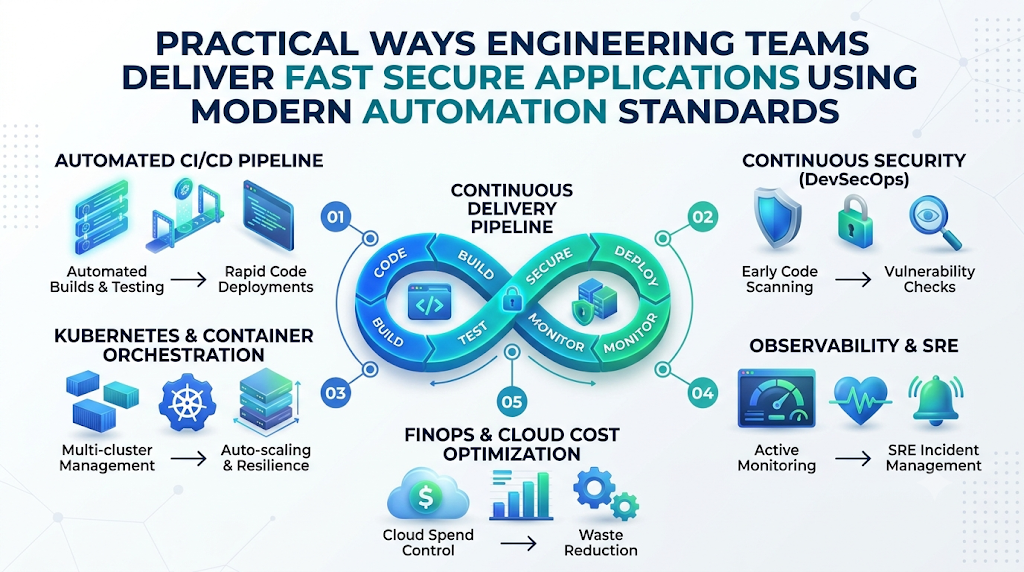
Introduction
Every growing company in the Netherlands relies on dependable web software to serve customers. Old software habits slow down delivery because separate departments rarely talk to each other. Coders write new features in isolation, while system operators scramble to prevent system crashes. When these groups join forces, companies release reliable tools at blistering speed. This fresh cooperative method removes workplace tension and protects digital assets. Today, ambitious workers need these modern cloud abilities to secure top-tier engineering roles. DevOpsSchool guides businesses and individual students through every stage of this operational upgrade. Our detailed walkthrough examines automated pipes, container clusters, security practices, and financial controls. Master these practical techniques to elevate your technological capabilities.
What Is DevOps, and Why Does It Matter?
DevOps unites software builders and system administrators into one cohesive unit. Builders compose raw text commands that tell computers how to act. Administrators ensure physical machines and cloud networks run without interruptions. Traditionally, coders tossed their finished files across a wide organizational gap. Administrators then spent painful nights repairing broken software setups. Today, both sides collaborate daily using shared digital workstations. Automated tools evaluate every fresh line of code without human delay. This continuous testing catches defects before customers ever notice them. A defect is simply an unintentional flaw in a program. Automation frees humans from tedious manual checks every afternoon. Consequently, teams deploy stable product updates smoothly and keep users satisfied.
| Service Track | Core Objective | Primary Beneficiary |
|---|---|---|
| Workflow Advisory | Streamline release pipelines and connect divided teams | Maturing companies with tangled software procedures |
| Practical Coursework | Master modern skills through direct terminal practice | Ambitious career changers and fresh engineers |
| Group Instruction | Align entire technical divisions on uniform practices | Large corporations seeking operational consistency |
| Integrated Defense | Block cyber intrusions before code reaches production | Organizations handling private payment records |
| Container Orchestration | Coordinate modular application boxes across massive server farms | High-volume online merchants and mobile platforms |
| Cloud Relocation Strategy | Shift on-premise digital assets to remote web infrastructure | Legacy firms burdened by aging office machinery |
DevOps Consulting Netherlands
Dutch companies often seek faster delivery cycles, yet outdated development habits hold them back. Bringing in DevOps Consulting Netherlands enables managers to pinpoint operational friction immediately. External specialists observe engineering habits directly inside the client environment. They guide staff in designing dependable continuous integration and deployment pipelines. These pipelines act as automated assembly lines that assemble, verify, and package software. Modern deployment pipelines eliminate manual typing errors during tense production releases. Team members learn to cooperate constructively instead of trading insults over sudden outages. Eventually, technical staff spend far fewer weekend hours fixing unexpected application crashes. They gain valuable time to invent features that outpace business competitors. Competent guidance converts chaotic release days into smooth, predictable routines.
DevOps Training Netherlands
Technical specialists must expand their capabilities to command attractive market compensation. Enrolling in DevOps Training Netherlands grants students immediate access to authentic cloud environments. Learners never spend hours memorizing dense theoretical manuals. Instead, they access live interactive sandboxes that replicate real company infrastructure. Students write code, trigger automated testing pipelines, and fix simulated production failures. Learners deploy functioning websites and connect them to secure storage databases. A database is an electronic filing cabinet that organizes user records. Seasoned mentors guide candidates through sticky troubleshooting exercises. Students also prepare for rigorous industry certifications that hiring managers actively seek. An official certification validates your technical ability to skeptical recruiters. This rigorous practice prepares individuals for demanding technology assignments.
Corporate DevOps Training
Enterprises thrive when their entire engineering roster executes projects from a common playbook. Scheduling Corporate DevOps Training allows complete business units to adopt modern development practices simultaneously. Often, separate development squads within one firm rely on contradictory toolkits. One squad might test software manually, while another writes automated execution scripts. A script is an executable list of computerized instructions. Conflicting approaches lead to missed project targets and broken system interfaces. Coordinated workshops gather developers and system operators into one collaborative workspace. Engineering personnel build genuine enterprise features during these guided group sessions. Shared study builds deep workplace empathy between coders and support staff. The enterprise moves forward decisively because everyone pulls in the same direction.
DevSecOps Consulting Services
Digital protection requires continuous attention in an interconnected commercial landscape. Malicious hackers probe online systems constantly to extract customer credentials and private records. Implementing DevSecOps Consulting Services embeds protective safeguards straight into automated software pipelines. DevSecOps means teams verify system integrity during every stage of application creation. In previous decades, compliance inspectors reviewed software only moments before public release. That sluggish checkpoint delayed critical product updates for weeks. Modern security scanners inspect written commands continuously while developers type at their desks. The security scanner raises an alarm whenever an engineer exposes sensitive endpoints. Next, the engineer patches the vulnerability before attackers detect the weakness. Proactive security controls help organizations satisfy strict European data protection mandates effortlessly.
Kubernetes Consulting Services
Modern cloud applications consist of hundreds of tiny modular programs called containers. A container packages application code alongside all necessary supporting files. Managing thousands of individual containers without automation quickly overwhelms human administrators. Therefore, engineering departments rely on Kubernetes to control large container fleets. Kubernetes functions as an automated pilot for massive digital container environments. It relocates application services to functional computers whenever an underlying machine fails. It also activates additional application replicas whenever internet shoppers overwhelm an online store. Securing Kubernetes Consulting Services helps firms launch these sophisticated orchestration networks safely. Advisors show internal engineers how to configure clusters while avoiding expensive performance traps. Consequently, critical online services stay responsive during massive surges in visitor activity.
Kubernetes Training Netherlands
Controlling containerized environments ranks among the most valuable skills in modern technology. Registering for Kubernetes Training Netherlands equips learners with essential container administration techniques. Students begin by encapsulating simple applications inside Docker images. Next, they bundle complex multi-tiered services using Helm chart templates. Learners execute direct administrative commands inside simulated command-line terminals. Instructors guide students through realistic cluster failures within protected practice zones. Candidates learn to revive failed application pods within seconds. This intensive practical work prepares students to tackle the demanding CKA and CKAD examinations. Passing these challenging credentials demonstrates operational maturity to enterprise recruiters. Direct laboratory drills transform intricate terminal commands into second nature.
Site Reliability Engineering Consulting
Visitors abandon digital storefronts whenever pages load slowly or crash unexpectedly. Contracting Site Reliability Engineering Consulting ensures web platforms remain resilient, responsive, and dependable. SRE applies disciplined software engineering principles to solve messy system administration challenges. Reliability engineers establish measurable targets called service level objectives. A service level objective represents an explicit contractual standard for system uptime and performance. Specialists install telemetry sensors across distributed servers to monitor operational health. When an application stalls, the monitoring framework notifies engineers instantaneously. The engineering squad resolves the underlying technical defect without delay. Afterwards, they draft comprehensive incident reports to prevent identical failures in the future. Disciplined reliability engineering ensures online platforms function smoothly every single day.
Cloud Migration Consulting Netherlands
Physical office server racks demand expensive maintenance, cooling, and electricity. Contemporary enterprises favor storing digital workloads on massive remote server networks known as the cloud. Utilizing Cloud Migration Consulting Netherlands helps business leaders navigate this complex relocation safely. Specialists evaluate legacy applications to identify compatibility issues before transferring any data. They select resilient hosting environments across Amazon Web Services, Microsoft Azure, or Google Cloud. The migration squad replicates essential enterprise files methodically to prevent accidental data loss. They validate application performance in the new cloud zone prior to decommissioning physical equipment. This systematic execution protects the enterprise from disruptive service outages or lost customer transactions. Transitioning to cloud infrastructure slashes facility overhead and supports effortless international scaling.
Hire Freelance DevOps Engineers
Occasionally, a business requires immediate specialized talent to execute a time-sensitive digital assignment. Under these circumstances, executives can Hire Freelance DevOps Engineers to supply crucial missing skills. These independent contractors integrate into internal teams and produce results immediately. However, management must vet every applicant’s real-world problem-solving abilities thoroughly. Team leads should examine past code repositories and verify completed infrastructure deployments. The engagement contract must outline exact deliverables, milestones, and intellectual property terms. Precise agreements prevent costly misunderstandings regarding code ownership and operational duties. Seasoned contractors introduce fresh techniques and transfer practical knowledge to permanent employees. After the project concludes, the organization retains a robust, modern software architecture.
FinOps Consulting Services
Operating expansive cloud environments becomes financially ruinous when teams neglect resource governance. Engaging FinOps Consulting Services equips organizations to monitor and contain their monthly cloud invoices. FinOps combines disciplined fiscal accounting with daily infrastructure management habits. Developers frequently forget to terminate temporary test environments prior to holiday weekends. Those orphaned virtual machines drain corporate funds continuously while sitting idle. Specialists construct transparent dashboards that track real-time server expenditures across multiple cloud providers. They configure automated spending thresholds that sound alarms whenever consumption spikes unexpectedly. Teams learn to decommission idle computing power and choose cost-effective instance sizes. Diligent financial governance satisfies corporate accountants while maintaining peak application performance.
| Strategic Focus | Operational Workflow | Measurable Outcome |
|---|---|---|
| Pipeline Modernization | Construct automated CI/CD software highways | Reduce delivery schedules from months to hours |
| Interactive Instruction | Practice administrative tasks inside live sandboxes | Attain recognized certifications and secure higher wages |
| Enterprise Alignment | Train distributed engineering squads simultaneously | Establish uniform engineering vocabulary across departments |
| Continuous Protection | Scan application text continuously during development | Seal security exposures and safeguard private consumer records |
| Cluster Administration | Coordinate distributed services inside isolated containers | Preserve service availability during peak consumer events |
| Expenditure Oversight | Audit cloud invoices using active monitoring dashboards | Eliminate waste caused by forgotten computing capacity |
Real-Life Scenarios / Experiences
- A Dutch online florist suffered catastrophic website outages every year on Valentine’s Day. The technical team migrated the storefront onto a self-healing Kubernetes cluster. Now, the platform activates dozens of temporary container instances whenever shopper volume surges. The website maintains lightning-fast performance, allowing the shop to fulfill record flower orders without a single crash.
- A mid-sized logistics firm spent four weeks manual-testing every minor software update. Engineers verified interface buttons by hand using cumbersome spreadsheets. The management team engaged an outside advisor to establish automated delivery pipelines. Now, engineers push tested bug patches to live servers every single afternoon without operational hiccups.
- A traditional database administrator wanted to transition into cloud engineering. He registered for an intensive weekend training track featuring hands-on laboratory exercises. He practiced container commands daily and earned his CKA certificate on his initial attempt. Within eight weeks, a premier Amsterdam software firm hired him as an infrastructure engineer.
- A financial software startup faced staggering monthly bills from their cloud provider. They hired a financial management consultant to audit their remote server sprawl. The consultant discovered eighty active development machines that engineers had abandoned months earlier. Terminating those dormant machines reduced the company’s monthly hosting expenses by thirty-five percent immediately.
Common Mistakes to Avoid
- Bypassing automated test suites to meet unrealistic product deadlines causes severe production outages later. Skipping automated verification allows critical programming defects to reach paying customers unnoticed. Always enforce automated pipeline tests before permitting code into live environments.
- Isolating software programmers from infrastructure operators breeds unnecessary workplace hostility. Divided departments waste valuable hours shifting blame whenever unexpected system crashes occur. Unify coders and operators into balanced cross-functional squads with shared performance incentives.
- Postponing cybersecurity evaluations until the final days of a development cycle wastes enormous engineering resources. Late security interventions force programmers to rewrite completed features from scratch. Integrate automated security scanning engines directly into daily development pipelines.
- Adopting complex container clusters before your engineering team understands basic server administration creates chaos. Complicated management tools confuse inexperienced staff and complicate simple application tasks. Master standard container commands thoroughly before deploying large-scale production clusters.
- Migrating messy legacy software straight to cloud environments without prior refactoring amplifies technical debt. Transferring poorly organized code to the cloud yields expensive, unreliable cloud infrastructure. Refactor application dependencies and eliminate dead code before moving workloads to remote data centers.
- Postponing cloud bill reviews until the fiscal quarter ends invites massive budget overruns. Surging cloud costs can consume critical operating capital before executives spot the issue. Implement active cost monitoring alerts to catch runaway compute charges instantly.
- Hiring freelance technical contractors without evaluating their practical terminal skills invites project failure. An impressive curriculum vitae cannot substitute for demonstrated command-line competence. Require every candidate to solve a live troubleshooting exercise on a practical terminal before extending an offer.
- Running distributed cloud software without real-time telemetry dashboards leaves support teams in the dark. Operating blind forces support personnel to rely on angry user complaints to detect broken systems. Deploy continuous monitoring frameworks to detect system degradation before users experience service disruptions.
How to Choose the Right Service
Begin by gathering your engineering leaders to diagnose your most urgent operational bottlenecks. Do broken software updates stall your business, or do uncontrolled cloud bills deplete your margins? When internal personnel lack baseline cloud competence, enrolling staff in structured coursework yields immediate returns. Conversely, if your software deployments crash frequently, engaging seasoned advisory consultants solves structural defects faster. Next, scrutinize prospective course syllabi to verify that programs include dedicated sandbox lab hours. Passively watching video lectures never transforms a novice into an effective, confident infrastructure specialist. When evaluating consulting partners, demand clear case studies detailing past engineering triumphs. Confirm that the consultant’s proposed project boundaries align with your fiscal constraints and delivery timetables. DevOpsSchool delivers both targeted advisory services and hands-on technical instruction tailored to diverse experience levels. Assess your immediate operational gaps thoroughly to allocate your development budget effectively.
Frequently Asked Questions
1. What does the term DevOps mean in simple words?
DevOps describes a workplace culture where programmers and infrastructure administrators cooperate as a unified group. Historically, these two factions operated in separate rooms and blamed each other for operational failures. Today, they rely on automated software tools to test and ship applications rapidly. This collaborative workflow enables modern companies to update online platforms daily while avoiding catastrophic software bugs.
2. Why do Dutch businesses hire DevOps consulting firms?
Organizations hire external consulting firms because internal software release processes take far too long. Seasoned advisors examine existing technical workflows and expose time-consuming manual checkpoints. They construct automated delivery systems that eliminate human error from routine updates. This specialized guidance helps businesses roll out competitive features swiftly while keeping mission-critical systems healthy and responsive.
3. How does hands-on training help beginners learn cloud tools?
Aspiring engineers learn technical subjects fastest when interacting directly with real computer systems. Practical training programs grant students continuous access to authentic digital workspaces. Learners execute shell commands, launch web services, and resolve simulated infrastructure breakdowns safely. This practical repetition creates lasting muscle memory, empowering candidates to clear demanding certification tests and conquer workplace challenges.
4. What is the main goal of corporate team training?
Corporate instruction aligns an entire company’s technical personnel behind identical delivery methodologies. When separate engineering squads use disconnected toolkits, they introduce system inconsistencies and miss crucial business milestones. Group workshops ensure developers and operators speak a unified technical language. This shared operational foundation accelerates delivery timelines and cultivates deep mutual trust across all engineering divisions.
5. How does DevSecOps protect digital user records?
DevSecOps embeds automated vulnerability evaluations directly within the standard software assembly pipeline. Traditional development teams reviewed software security solely at the conclusion of extensive projects. That obsolete process delayed major releases for weeks. Modern automated scanners inspect written lines of code while engineers type. These tools identify security holes early, shielding customer identities and account credentials from digital predators.
6. What makes Kubernetes so helpful for modern applications?
Kubernetes operates as an automated command center for collections of application containers. Whenever an underlying computer malfunctions, Kubernetes instantly shifts affected workloads onto healthy hardware. It also generates additional application copies whenever heavy customer traffic threatens to overwhelm servers. This automated orchestration keeps web platforms fully operational without requiring engineers to monitor machines overnight.
7. What skills do students learn in Kubernetes classes?
Students learn how to isolate computer applications into portable packages using Docker containers. Next, they practice managing complex container groups using Helm deployment templates and native administrative utilities. Instructors share tactical methods for mastering the prestigious CKA and CKAD certification assessments. Participants graduate ready to construct, monitor, and troubleshoot production-grade container clusters with absolute poise.
8. What is the job of a Site Reliability Engineer?
A Site Reliability Engineer applies disciplined software coding methods to preserve website availability and performance. These professionals construct automated monitoring screens that track server health metrics around the clock. When an application exhibits sluggish behavior, the telemetry framework notifies the engineer instantly. SREs diagnose root causes rapidly so customers enjoy uninterrupted, dependable online experiences.
9. Why do companies need help with cloud migration projects?
Transferring complex business records from localized server closets to remote cloud networks presents significant risks. A single configuration error can corrupt sensitive corporate information permanently. Migration consultants engineer every transitional step carefully to eliminate potential operational disruptions. They migrate applications across AWS, Azure, or Google Cloud smoothly without forcing the business to halt customer operations.
10. When should a company hire freelance tech engineers?
Enterprises hire freelance specialists when they need immediate niche expertise for a specific project. For instance, a firm might require an outside engineer to establish a secure container cluster within sixty days. Independent contractors begin work immediately without enduring lengthy corporate hiring procedures. This agile staffing model controls overall payroll expenses while transferring advanced skills to permanent employees.
11. How does FinOps keep cloud computing costs under control?
FinOps bridges corporate accounting strategies with day-to-day infrastructure management routines. Engineers frequently abandon active test machines, wasting substantial financial resources every single day. FinOps specialists implement transparent expenditure monitors that expose real-time cloud costs. They configure automated threshold alerts that sound alarms whenever consumption climbs, keeping engineering departments strictly accountable for their cloud footprint.
12. How can I evaluate DevOpsSchool for my team needs?
Explore the company’s primary website to review their catalog of educational programs and consulting offerings. Inspect their hands-on lab environments, curricular frameworks, and student mentorship resources. DevOpsSchool provides tailored corporate workshops, weekend classes for individual learners, and comprehensive enterprise consulting. Aligning their specialized educational tracks with your organizational goals guarantees rapid acquisition of modern technical abilities.
CONCLUSION
Adopting disciplined cloud practices positions modern enterprises for sustained commercial achievement. Establishing automated delivery systems and operating resilient container clusters safeguards your company against aggressive competitors. Businesses ship dependable software rapidly, while engineering personnel enjoy tranquil work environments free from chaotic midnight emergencies. Nevertheless, you must select training tracks and consulting services that resolve your precise operational obstacles. Avoid chasing expensive industry fads when your team merely requires foundational automated testing routines. Audit your existing delivery habits carefully, discuss needs with your technical staff, and choose an appropriate growth track. To discover comprehensive training curriculums, senior advisory services, and practical career resources, consult DevOpsSchool at https://www.devopsschool.nl/ right away.
Leave a Reply